How to Research a Memecoin in Five Minutes
Eight checks, in order, that filter out most of what goes wrong.

Merlin
Author

Most people either do no research or do too much of the wrong kind. Reading the Telegram for twenty minutes tells you almost nothing. Eight specific checks in five minutes tell you most of what matters.
Here's the sequence. It gets faster with practice.
1. Confirm the contract address (30 seconds)
Get it from the project's official channel, cross-check on a screener, and never take it from a DM or a search result. Copycat tokens are the most common way people lose money, and it's entirely avoidable.
2. Liquidity against market cap (30 seconds)
Read the liquidity figure, then read it against the market cap. Under a few percent means the valuation is largely theoretical and you'll struggle to exit. Then check whether it's locked, burned, or neither. The full reasoning is in what is liquidity.
3. Top-ten holder percentage (30 seconds)
What share of supply do the largest ten wallets hold? Over 30% means a small group can end it. Learn to recognise pool contracts and burn addresses in that list so you're not passing on tokens for the wrong reason. Covered in holder distribution.
4. Holders against volume (30 seconds)
Is the holder count rising with the price, or flat while volume climbs? Flat holders with heavy volume is the wash trading signature. Rising holders is real interest. This is the single most useful ratio on the page.
5. Transactions against makers (20 seconds)
Eight hundred transactions from sixty wallets is sixty wallets churning, not eight hundred people. Low makers relative to transactions means the activity is narrow.
6. Bundle check (40 seconds)
Run it through a bundle checker. Look for what share of supply was taken in the first block, how many wallets, and whether they've sold. A large bundle still holding is a pending dump. Details in what is a bundled token.
7. Contract panel (40 seconds)
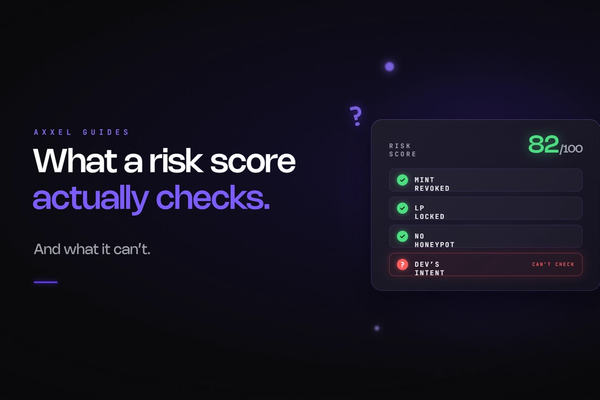
Mint authority, freeze authority, whether the sell tax can be changed, whether the contract is renounced. On Solana, freeze authority still live is disqualifying on its own. On EVM chains, a mutable tax is a honeypot waiting for a decision.
8. Deployer history (40 seconds)
Look up the wallet that created it. Forty previous tokens all dumped is the most useful thing you'll learn. A clean deployer isn't a guarantee, but a dirty one is close to a rule.
Then, if it passes: the test sell
Buy a small amount and immediately sell a portion. Ten seconds and a couple of dollars, and it's the only check a contract designed to pass scanners can't fool. Confirms the token is sellable right now, which is what you actually need to know.
What the routine catches
Copycats, thin liquidity, concentrated supply, manufactured volume, bundled launches, mutable contracts, serial ruggers, and static honeypots. That's most of the ways a token is set up to take your money.
What it doesn't
A deployer who changes their mind next week. A narrative that dies. A token that passes every check and goes to zero because nobody cares about it, which is most of them. The routine filters out the broken ones. It doesn't find the good ones, and it doesn't change the base rate.
Which is why the ninth step, the one that isn't on the list, matters most: size it as though it's going to zero anyway.
Making it automatic
Some of this can be set once. Maximum buy and sell tax limits mean orders won't fire on tokens that breach them. Saved screener filters mean you're only looking at things that already clear the liquidity and holder floors. That doesn't replace the routine, but it means you're running it on a shortlist rather than on everything.
The tools are in the DexScreener guide and the rug pull checklist, which this piece sequences rather than replaces.
Axxel includes token analysis and configurable tax limits alongside market, limit, trailing and sniper orders, stop loss and take profit, MEV protection and slippage controls across Ethereum, Base, BSC, Solana and Robinhood Chain. Flat 0.9%, non-custodial, no subscription.
Five minutes. Every time. The people who skip it are the ones who fund the people who don't.
Crypto trading carries risk. Most memecoins lose value. Nothing here is financial advice. Axxel is not available in all regions.