The Most Expensive Mistakes New Memecoin Traders Make
Not the ones you'd guess. Ranked by what they actually cost.

Merlin
Author

Ask anyone how they lost money on memecoins and you'll hear about a rug. That's the story that gets told, because it's the one where it wasn't your fault.
The actual list is more boring and more expensive. Here it is, roughly ordered by what each one costs across everyone doing it.
1. Position sizing, by a distance
The single largest cause of ruin and it isn't close.
Someone takes a position that's fine on a token that's fine, then takes a much larger one on the trade they're certain about, and that's the one that goes to zero. Twenty good trades get erased by one oversized position, and the recovery maths is brutal: down 50% needs 100% to get back, down 80% needs 400%.
The fix is arithmetic rather than discipline. Size every position as though it's going to zero, because most of them will. If a total loss would materially hurt, it's too big. Covered fully in position sizing.
2. Never deciding when to sell
Second biggest, and it doesn't feel like a mistake while it's happening.
You're up 3x and it feels too small to bother. Up 8x and selling feels stupid. It pulls back 30%, that's healthy. Pulls back again and now you're waiting to get back to where you were.
Nobody gets rugged out of a 10x. They watch it come back down.
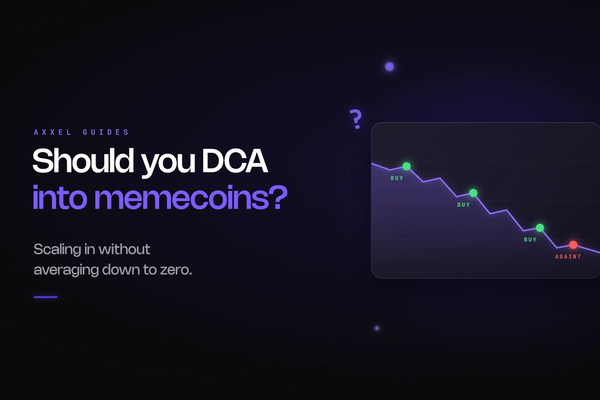
The fix is making the decision while you're calm and removing yourself from the execution — a limit sell at your target, a trailing stop for everything else, both set at the same time as the entry. Full breakdown here.
3. Not checking liquidity before sizing
Quieter than the first two and it catches people who otherwise do everything right.
A position can be correctly sized against your bankroll and completely wrong for the pool it's sitting in. If you're a meaningful share of the available exit, the price on screen isn't a price you can get. People discover this at exactly the wrong moment.
Read liquidity against market cap before you size, every time. It takes ten seconds.
4. Buying the wrong token entirely
Sounds like it shouldn't happen and it happens constantly.
Every trending token has copies with the same name, the same logo and a different contract. Search a ticker on a screener and you'll get all of them. The fake is often the top result, and it exists specifically to catch people who searched instead of pasting.
Get the contract from the project's own channel. Cross-check it. Never take one from a DM or a reply.
5. Cranking slippage out of frustration
Transaction fails, you raise slippage, it fails again, you raise it to 40%, it fills — badly.
Your slippage setting is public information in the mempool. Setting it high tells bots exactly how much you're willing to overpay, which is precisely how sandwich attacks pick targets. If a buy keeps failing, check whether the token has a tax before you keep raising the number — that's usually the actual reason. More in what is slippage.
6. Running everything from one wallet
Every site you connect to gets an approval, and approvals persist for years. Do this from one wallet for a year and a single bad signature reaches everything you own.
Separate wallets for holdings, trading and anything unknown. This is ten minutes of setup and it's the difference between losing a trading balance and losing everything — wallet setup guide.
7. Chasing a loss
Down on the day, so size up on the next one to make it back.
Feels rational in the moment and it's the most reliable way to end a run. The next trade has the same base rate as every other trade; what's changed is that you're now emotionally compromised and betting larger.
8. Treating correlated positions as diversification
Ten memecoins on the same chain in the same meta is one bet with ten tickets. When the meta turns, they turn together, and the "spread" you thought you had was never there.
9. Believing the market cap
A $50m market cap on $200k of liquidity is not $50m of anything. Market cap is a multiplication, not a measure of money in — and on thin pools it's mostly a number on a screen. More here.
10. Reacting to every dip
On a memecoin, 15% is Tuesday. Selling on noise means getting shaken out of everything before anything works, and it's the mirror image of never selling.
What's not on this list
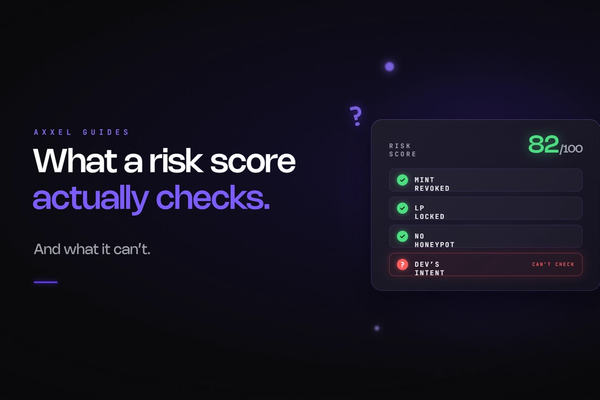
Rug pulls. They happen, they're worth checking for, and the checks take under a minute. But across everyone trading, they cost far less than the ten things above, all of which are entirely within your control.
That's the useful reframe. Most of what loses people money isn't done to them.
If you fix two things
Size for a total loss, and set your exit at the same time as your entry.
Those two cover most of the list. Everything else is refinement.
Axxel supports limit and trailing orders, configurable slippage and buy/sell tax limits, and MEV protection across Ethereum, Base, BSC, Solana and Robinhood Chain — so the exit can be set the moment you enter rather than decided under pressure. Flat 0.9%, non-custodial, no subscription.
Crypto trading carries risk. Most memecoins lose value. Nothing here is financial advice. Axxel is not available in all regions.