What Is a Limit Order? And Why Most Memecoin Traders Never Use One
The order type that does your thinking for you, and the reason people avoid it.

Merlin
Author
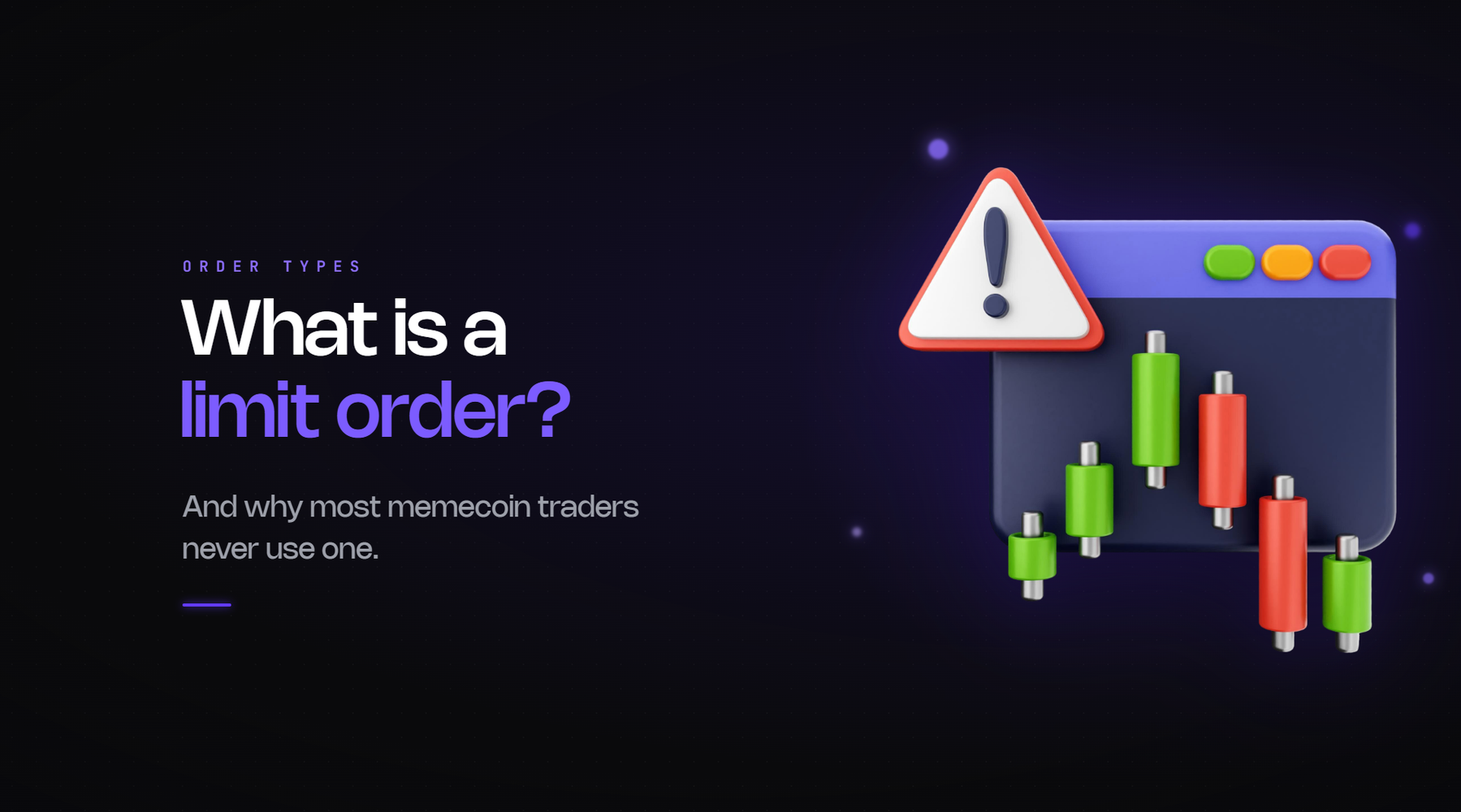
Almost everyone trading memecoins uses market orders exclusively. Paste a contract, hit buy, take whatever price the pool gives you.
That's fine for a fast entry and it's the wrong default for almost everything else.
The distinction
A market order executes immediately at whatever price is available. You get certainty of execution and no control over price.
A limit order executes only at a price you specify or better. You get control over price and no certainty of execution.
That's the entire trade-off. Everything else follows from it.
Why it matters more on memecoins than anywhere else
On a deep, liquid market the difference between the two is small — you'll fill near the quoted price either way.
On a thin memecoin pool it isn't small. A market buy moves the price as it executes, so you're paying progressively more for each token as you go. Add slippage on top and the gap between what you saw and what you got can be substantial.
A limit order caps that. You've stated a price and the trade either happens at it or doesn't.
Where limit buys actually earn their place
Buying a level rather than a moment. You've decided a token is interesting at $8m but not at $14m. A limit buy sits there and executes if it comes back. You don't have to watch, and you don't have to make the decision at 3am when it dips.
Not chasing. The most expensive habit in memecoin trading is buying something because it's moving. A limit order set in advance means you're buying at a price you chose while calm rather than at a price the market chose while you were excited.
Fading volatility. On something moving violently in both directions, resting orders below the current price sometimes fill on a wick and then recover. Risky, and it's a real strategy.
Where limit sells matter more
This is the bigger use case, and it's where the discipline actually shows up.
If you've decided you're taking profit at 3x, you can place that order the moment you enter. Then the decision is done — no deciding in the moment, no talking yourself out of it, no being asleep when it hits.
This is the entire argument. The problem with selling isn't knowing what to do, it's that the decision gets made at the worst possible time — when you're emotionally invested and the group chat is saying 100x. A limit order removes you from that moment.
Why people don't use them
Three reasons, and only one is rational.
Fear of missing the fill. If it never comes back to your price, you're out entirely. That's a real cost, and on a token that runs from your entry it's a painful one.
Optimism. Setting a sell target means naming a number you'd be happy with, which feels like capping your upside. People avoid it precisely because they want the ceiling to be unlimited — and then round-trip the whole position.
They don't know it's available. Genuinely common. Most people arrive at memecoins through a swap interface where market orders are the only option, and never look for anything else.
Limit versus trailing stop
Different jobs.
Limit sell handles "get me out at this number." Fixed target, executes when reached, done. Best when you have a specific level in mind.
Trailing stop handles "get me out when it turns." Follows the price up and triggers on a set giveback from the high. Best when you don't want to guess the top.
Most people who use both put a limit sell at a target to take partial profit, and a trailing stop underneath the rest. Take half the position off at a number you're happy with, let the remainder run with protection.
Practical points
Set it when you enter, not later. The value is entirely in making the decision while you're rational. Placing it an hour after entry has already lost most of the benefit.
Be realistic about the level. A limit sell at 50x on something that's never done 3x is a decoration, not a plan.
Check it still makes sense. A resting order from three weeks ago on a token whose narrative has completely changed isn't discipline, it's neglect.
Size to the pool. A large limit order on thin liquidity may only fill partially, or fill and move the price against the rest of it.
Setting them up
Axxel supports limit buys and sells alongside trailing stops, stop loss and take profit, and sniper orders across Ethereum, Base, BSC, Solana and Robinhood Chain. Flat 0.9%, non-custodial, no subscription.
The mechanism is straightforward. The hard part is being willing to name a number in advance and then not interfere with it — which is also the entire skill.
Crypto trading carries risk. Most memecoins lose value. Nothing here is financial advice. Axxel is not available in all regions.