Should You DCA Into Memecoins? Scaling In Without Averaging Down to Zero
Buying in pieces works on majors. On memecoins it can quietly turn a small mistake into a big one. Here’s when to scale in, when to go in at once, and how to do it with limit orders.

Merlin
Author
Dollar-cost averaging, buying a fixed amount at regular intervals regardless of price, is the standard advice for Bitcoin. Price goes up over years, so buying steadily smooths out the timing. Memecoins are not that. Most of them go to zero, the ones that run do it in hours, and the median coin you DCA into is a coin you’re slowly feeding until it’s gone.
That doesn’t mean “all in at once” is right either. It means the question is wrong. The useful distinction isn’t DCA or no DCA, it’s scaling in versus averaging down.
Scaling in
Scaling in is splitting a position you’ve already decided on into pieces, bought as the trade confirms. You’ve done the research, you’ve sized the position, and instead of buying all of it at the first price you see, you buy a third now, a third if it holds a level, and a third if it breaks out. Each buy is a reward for the coin doing what you expected.
The point is that your average entry rises as the coin proves itself. You end up with the full position only on coins that are working, and a small position on coins that stalled. That’s the opposite of what most people do.
Averaging down
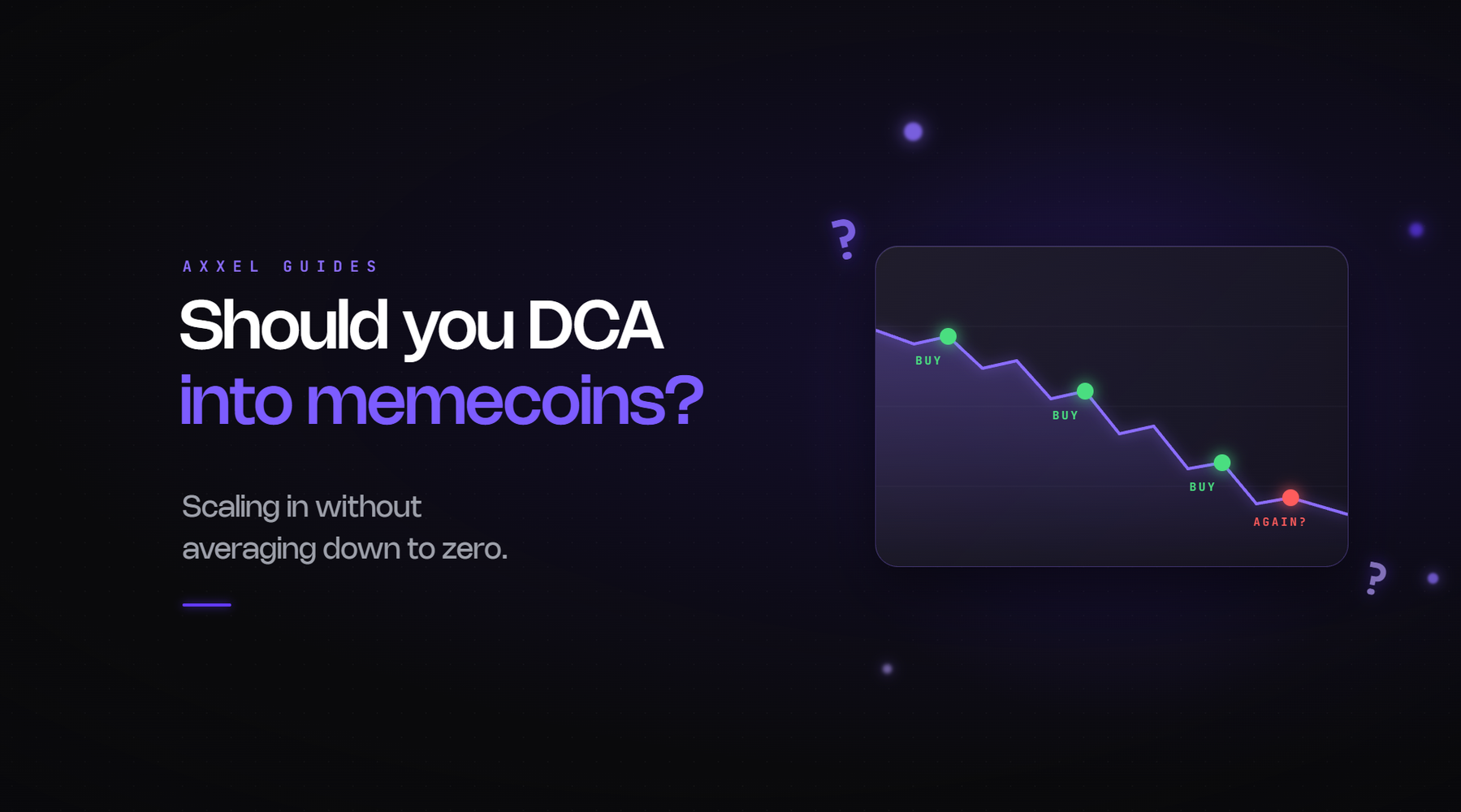
Averaging down is buying more because the price fell. The coin is 40% below your entry, you tell yourself it’s cheaper now, and you add. Your average comes down, your position goes up, and you’ve doubled your exposure to a coin that’s doing the opposite of what you expected.
On a major, that’s a reasonable bet because the asset isn’t going to zero. On a memecoin, a 40% drop from your entry is usually the start of the dump, not a discount. Why do I always buy the top covers the psychology behind it; the maths is that a coin down 80% from where you averaged in needs a 5x just to get you back to even.
The rule: add to winners, never to losers. If you wouldn’t open a new position in the coin at this price with fresh eyes, you shouldn’t be adding to an old one.
When buying in tranches makes sense
- A coin you’re confident in but that’s moving fast. Buying in three pieces over ten minutes gets you a fairer average than one market buy into a spike, and limits the damage from slippage on thin liquidity.
- A coin that’s consolidating. If a runner has pulled back and is building a base, a ladder of buys at the levels you’d expect it to hold means you’re paid for being patient instead of for guessing.
- A size that would move the market. If your full position is more than a couple of percent of the pool, your buy moves the price, and splitting it is just good execution.
When to go in at once
Launches, and anything where the edge is speed. If the reason for the trade is that you’re early, scaling in means being less early three times. Take the full position, set the stop, and let the trade decide.
How to ladder with limit orders
Scaling in by hand means sitting on the chart. Limit orders do it for you. Decide the three prices you’d buy at and the size at each, place all three, and close the app. If the coin only hits the first level, you own a third and you’re not sat with a full bag on a stalled chart. If it dumps through all three, the stop handles it. The limit order guide covers the mechanics.
The thing to avoid is placing the ladder below your entry “in case it dips”. That’s averaging down with extra steps. Ladders go at levels where the trade is still working, not at levels where it has already failed.
Scaling out is the same idea in reverse
Selling in pieces is how most profitable traders exit: a third at the first target to take the risk off, a third higher, and a trailing stop on the rest. Managing a memecoin position covers it properly. The symmetry is worth noticing: scale in while the coin proves itself, scale out while it pays you, and never add to a coin that’s doing neither.
Axxel supports Solana, Ethereum, Base, BNB Chain and Robinhood Chain, with limit orders for laddered entries, stop loss and take profit on every trade, trailing stops for scaling out, and adjustable slippage. The fee is a flat 0.9% on every trade, and your keys stay yours.
This article is for information only and is not financial advice. Crypto assets are high risk and you can lose everything you put in.