Why Does My Buy Move the Price? Price Impact Explained
You bought $500 of something and the chart jumped 8%. That’s not slippage, it’s you.

Merlin
Author
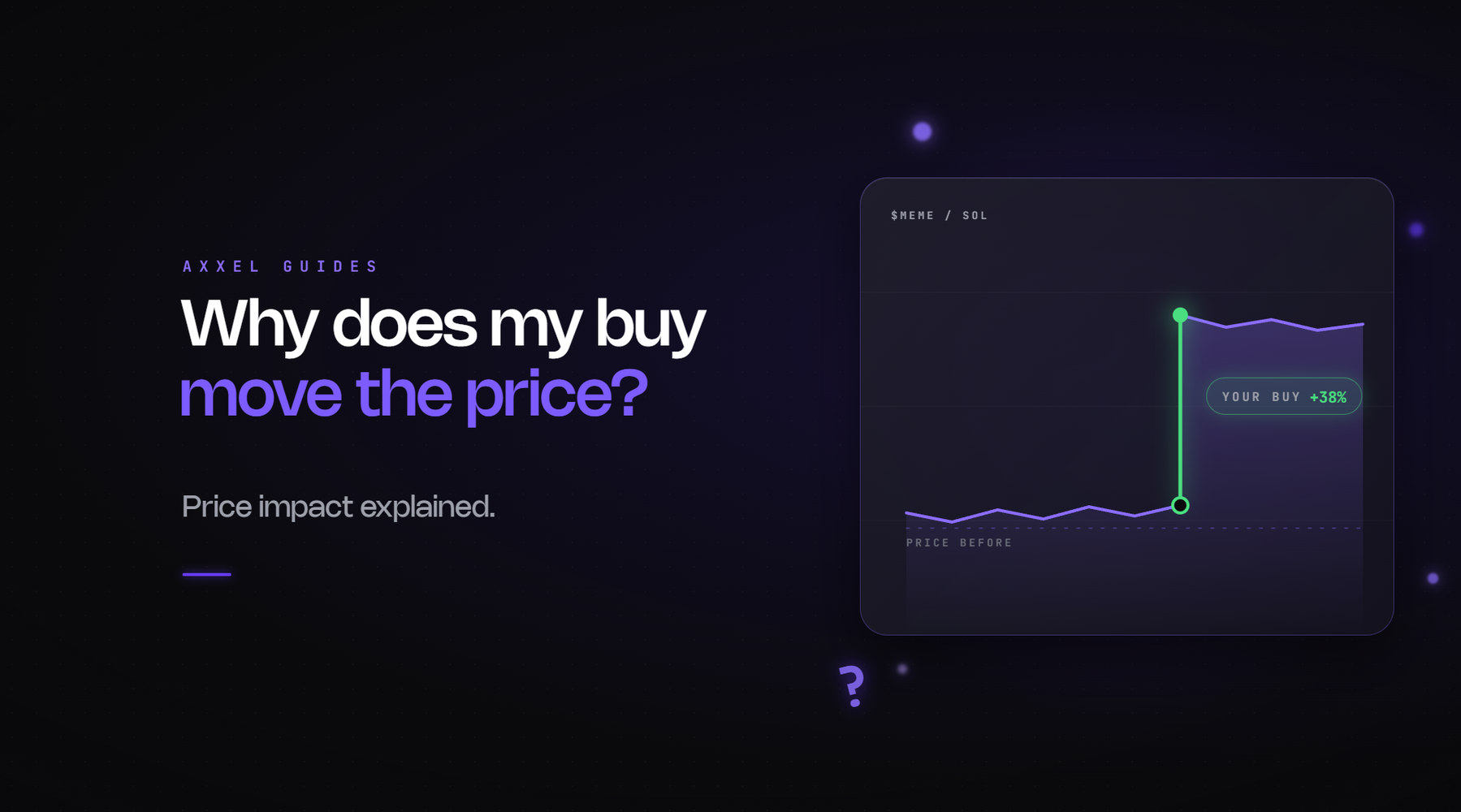
You buy $500 of a token. The chart ticks up the moment it fills, your entry price is higher than the price you clicked, and when you check, the token’s up 8% and you’re the reason. Then you sell and it drops the same way, and you’ve lost 15% on a round trip where the price never moved.
That’s price impact. It’s not a bug and it’s not slippage, and on small tokens it’s often the largest cost you pay.
Price impact versus slippage
Price impact is how much your own trade moves the price, because of how DEX pools work. There’s no order book. There’s a pool of two tokens, and buying one pushes its price up along a curve. The bigger your trade relative to the pool, the further along the curve you push it, and the worse your average price gets. You’d pay it on a chain with no other traders.
Slippage is the difference between the price you expected and the price you got because something changed between clicking and executing: someone else traded first, a bot front-ran you, the price moved. Slippage tolerance is the setting that decides how much of that you’ll accept.
They get confused because both show up as “I paid more than the price I saw.” But one is caused by the market, and one is caused by you, and you can see yours coming.
The maths, roughly
Price impact scales with your trade size as a fraction of the pool. On a pool with $300,000 of liquidity, a $3,000 buy is about 1% of the pool and moves the price around 2% against you. A $30,000 buy is 10% of the pool and moves it closer to 20%. It’s not linear. Doubling your size more than doubles the damage.
And you pay it twice, because selling pushes the price back down the same curve. A trade that costs 4% impact on the way in costs roughly 4% on the way out, so you’re 8% down on a flat market before the platform fee, the priority fee, or any tax the token charges.
What liquidity is covers why the pool size is the number that matters more than market cap.
How to see it before you buy
Most terminals and DEX interfaces show expected price impact next to the buy button, as a percentage, before you confirm. Read it. If it’s above 2 or 3% you’re buying too much for the pool, and if it’s above 10% you’re about to be the top of the chart.
If the interface doesn’t show it, the rough check is your trade size divided by the pool’s liquidity. Over 1% and it’ll be noticeable. Over 5% and it’s the biggest cost in the trade.
How to reduce it
Size to the pool, not to your bankroll. A position that’s fine for a $2 million pool is a disaster on a $100,000 one. The pool decides your maximum size, and that’s a hard constraint rather than a preference.
Split the entry. Three buys of $1,000 across a few minutes have less total impact than one of $3,000, because the pool rebalances between them as other traders act. Same on the way out, and it’s one of the reasons scaling out works better than one sell.
Use limit orders where the terminal supports them. A limit order at your price doesn’t chase the curve.
Avoid buying into the thinnest moment. Right after launch, on a bonding curve with almost nothing in it, every buy is a large fraction of the pool. That’s why early entries look like big percentage moves and why early exits give most of it back.
Why it matters more than people think
A trader doing twenty round trips a week on small pools at 3% impact each way is losing 6% of every position to their own footprint, before fees. On a $500 position that’s $30 a trade, $600 a week, and it never appears on any statement, because it isn’t a fee. It’s just a worse price, twice, every time.
Add priority fees and slippage on top and the true cost of trading thin tokens is often three or four times the platform fee people argue about. The full breakdown covers where the rest goes.
Axxel shows liquidity on every token alongside configurable slippage, limit and trailing orders, MEV protection and stop loss and take profit across Ethereum, Base, BSC, Solana and Robinhood Chain. Flat 0.9%, non-custodial, no subscription.
The chart moved because you did. Check the pool before you check the price.
Crypto trading carries risk. Most memecoins lose value. Nothing here is financial advice. Axxel is not available in all regions.