Why Do Memecoins Dump So Fast?
Up over days, down in minutes. The asymmetry isn't bad luck, it's seven mechanisms stacked on top of each other.

Merlin
Author
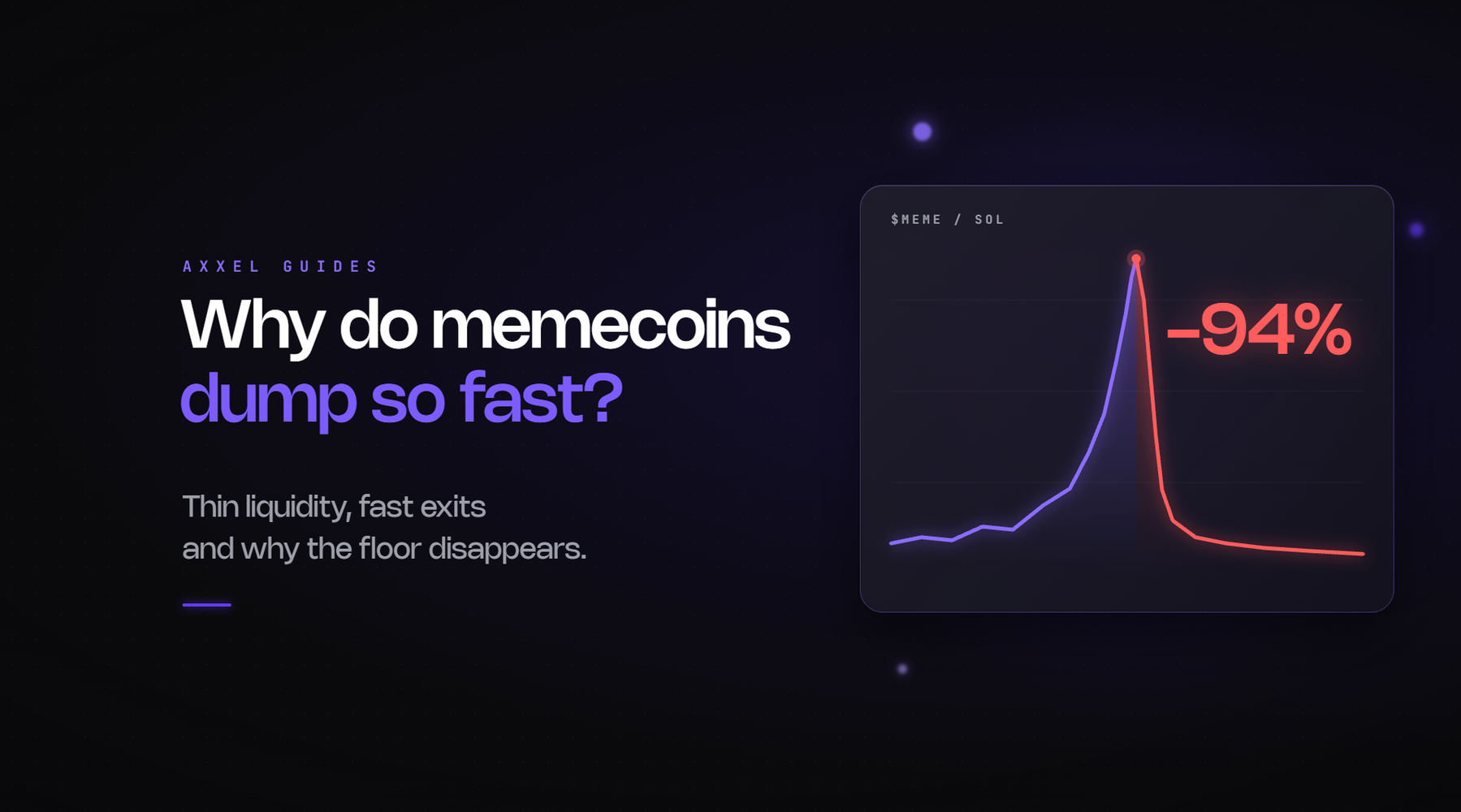
Everyone who's traded memecoins for more than a week has watched the same thing: a chart that climbed for days, then fell further in an hour than it rose in any of them. The asymmetry is so consistent it's worth understanding, because once you see the mechanics, the question stops being "why did it crash" and becomes "why would it not."
Seven things that make the downside faster
Thin liquidity. A $20 million market cap sitting on a $300,000 pool means a $50,000 sell moves the price double digits. On the way up, buyers arrive one at a time. On the way down, sellers arrive together, and the pool can't absorb them. What liquidity actually is covers the maths.
No bids underneath. Stocks have value investors waiting at lower prices. Memecoins have nothing below the current price but the people who haven't noticed yet. When a sell hits, there's no one there to catch it until the price finds someone who thinks it's cheap, which on a dead coin is nobody.
Reflexivity in reverse. Attention drives price, and a falling price kills attention. The timeline moves on, the group chat goes quiet, the new buyers who'd have slowed the fall are looking at something else. The same loop that made it run makes it collapse.
Everyone has the same exit. Stops clustered just under the obvious levels, bots programmed to sell on the same signals, and a few thousand people watching the same chart. When the level breaks they all sell at once, and the next level breaks because they did.
The insiders leave first. Bundlers, snipers and early wallets hold a disproportionate share and sell on the same cue, which is usually the first sign of weakness. Their exit is the first leg of the cascade. Everyone else's is the second.
Bad fills on the way out. Sellers in a panic set high slippage to make sure they get out, which means they take worse prices, which pushes the price lower faster. Sandwich bots front-run the big panic sells and make them worse.
There's nothing to anchor to. On a stock, a 50% drop makes someone say "that's cheap relative to earnings." A memecoin has no earnings, so a 50% drop is just information that it's going down, and people act on the information.
What a cascade looks like from inside
It starts slowly. A few red candles on thin volume, the kind you'd ignore. Then one large sell takes the price through a level, and the chart changes character in a single candle: the wicks lengthen, the volume spikes, the holder count starts dropping on the screener. The Telegram goes from "healthy pullback" to "is this a rug" to silence in about ten minutes.
Then the second wave, which is everyone who told themselves they'd sell if it went below X, all selling at X. By the time it stabilises it's typically 60 to 90% down from the top, and the people buying the "dip" are buying from the people who finally gave up.
Being on the right side
Exits set at entry. Not a mental note, an order. A stop loss placed when you bought executes while you're asleep or arguing in the chat. A mental stop executes never.
Scale out into strength. The only time there's enough liquidity to sell size is while it's going up. Selling a third at 3x and a third at 5x feels like leaving money on the table until the day it doesn't. When to sell.
Watch the top wallets, not the price. The insiders' sells come before the cascade, and holder distribution shows them moving while the chart still looks fine.
If you're selling into one, size and slippage. Split the sell, set slippage no higher than you need, and accept a worse price on part of it rather than a terrible one on all of it.
Don't catch it without a reason. A 70% drop isn't a level, it's a number. Will my memecoin come back has the checks for whether there's anything to catch.
Axxel supports stop loss and take profit, limit and trailing orders, configurable slippage and MEV protection across Ethereum, Base, BSC, Solana and Robinhood Chain, so the exit's an order rather than an intention. Flat 0.9%, non-custodial, no subscription.
The dump isn't the surprise. It's the base state. The surprise is being ready for it.
Crypto trading carries risk. Most memecoins lose value. Nothing here is financial advice. Axxel is not available in all regions.