Will My Memecoin Come Back? How to Tell a Dip From a Dead Coin
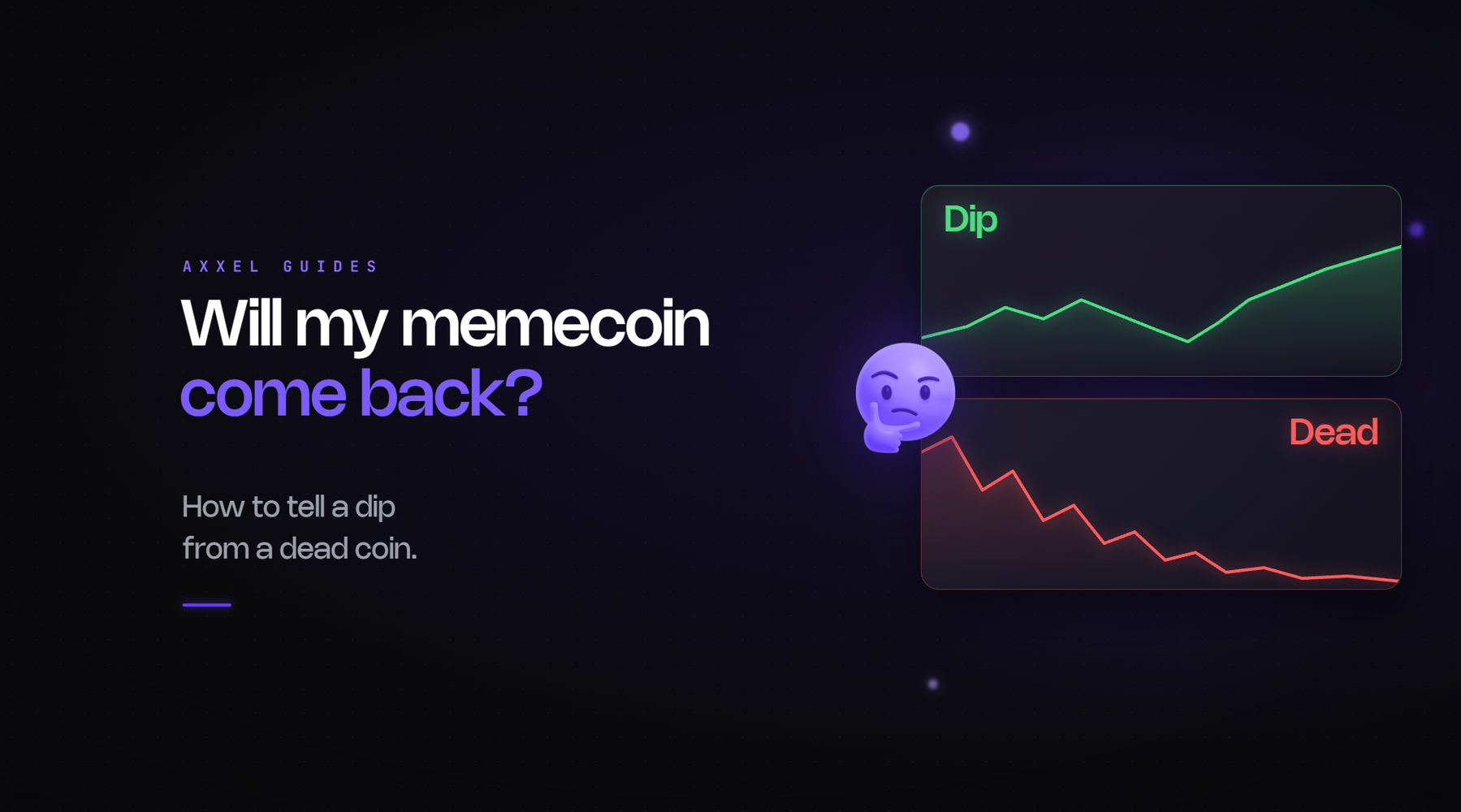
Most don't. Some do. Here's how to tell which one you're holding, and the question that settles it.

Merlin
Author
You're down 70%. Maybe 85. You check the chart more than you'd admit, and in the back of your head one question is running on loop: will it come back?
The honest answer first. Most don't. The share of memecoins that lose most of their value and then recover to where you bought is small, and it shrinks the longer the decline runs.
But some do. CATE topped around $90M, fell to roughly $25M, a 72% drawdown, and about four weeks later went through $100M to a new all-time high. It happens. The useful question isn't whether recoveries exist. It's whether you're holding one.
Six signals that separate a pullback from a slow death
Holders. The most important one. A holder count that's steady or growing through the drawdown means the base is intact: people are staying, and some are buying. A falling count means they're leaving, and a coin needs people to come back to. The mechanics are in reading holder distribution.
Volume. Dead coins don't hit zero volume overnight. It decays, day by day, until only bots and the occasional bagholder are trading. A coin that's consolidating keeps trading at meaningful volume relative to its size.
The big wallets. Check what the top holders and the deployer did on the way down. If they sold into the drop and left, the people with the most conviction and the most information have voted. If they held or added, that's a different signal.
The community. Is anyone still posting, making memes, building things? Or has the Telegram turned into "wen pump" and bots? Memecoins run on attention, and a community that's still producing content is still producing attention.
The narrative. Is the reason it ran still alive? A coin attached to a meta that's rotated away is swimming against the current. A coin that's become a mainstay of its chain, the one people reference when they talk about the category, has something to come back to.
Liquidity. Is there still a real pool, or has it thinned to the point where even a recovery wouldn't give you a price you could actually sell at? Covered in what is liquidity.
If most of these point the wrong way, you already know the answer. If most point the right way, it's a live position rather than a hope.
The question that settles it
Imagine you'd sold everything yesterday and had the cash instead. Would you buy this coin today, at this price, with that money?
If yes, holding is a decision. You're choosing to own it.
If no, holding is hope. You're only still in because selling would make the loss real.
The price you paid is irrelevant to what happens next. The market doesn't know your entry. Breakeven feels like a meaningful number and it isn't one; it's just the most memorable price on the chart.
The traps
Waiting for breakeven. The most common. Every rally gets measured against your entry, and the plan becomes "sell when I'm back to even." Either you never get there, or you get there, sell with relief, and watch it keep going. Both ways, the decision was made by your entry price rather than by the coin.
Averaging down. Buying more to lower your average feels like a strategy. On assets with a floor it can be. Memecoins don't have one, and a coin that's "cheap" at 80% down can lose another 80%. More in managing a memecoin position.
Checking constantly. Watching a losing position all day doesn't change it. It just means the next decision gets made tired and angry. The psychology piece covers why.
What to actually do
Decide and act. If the signals and the question say it's dead, sell and redeploy. Capital does nothing sitting in a coin you wouldn't buy.
Or keep a small piece. Sell most, keep a sliver as a lottery ticket. It removes the fear of missing a recovery without leaving your whole position exposed, and it's surprisingly effective at ending the agony.
Or set a level and leave. If you're holding deliberately, set a limit sell at a price you'd genuinely be happy with, and a stop at the point where you'd admit the thesis is gone. Then close the chart and let the orders do the watching.
Next time
This situation almost always starts at entry. An exit decided while you're calm, and a position sized as though it's going to zero, turns an 80% drawdown into an annoyance rather than a question you ask yourself at 2am. The when to sell guide covers setting it up.
Axxel supports limit and trailing orders, stop loss and take profit, and token analysis across Ethereum, Base, BSC, Solana and Robinhood Chain, so the level you'd sell at can be set once and left alone. Flat 0.9%, non-custodial, no subscription.
The chart doesn't know what you paid. Decide on what it's worth now.