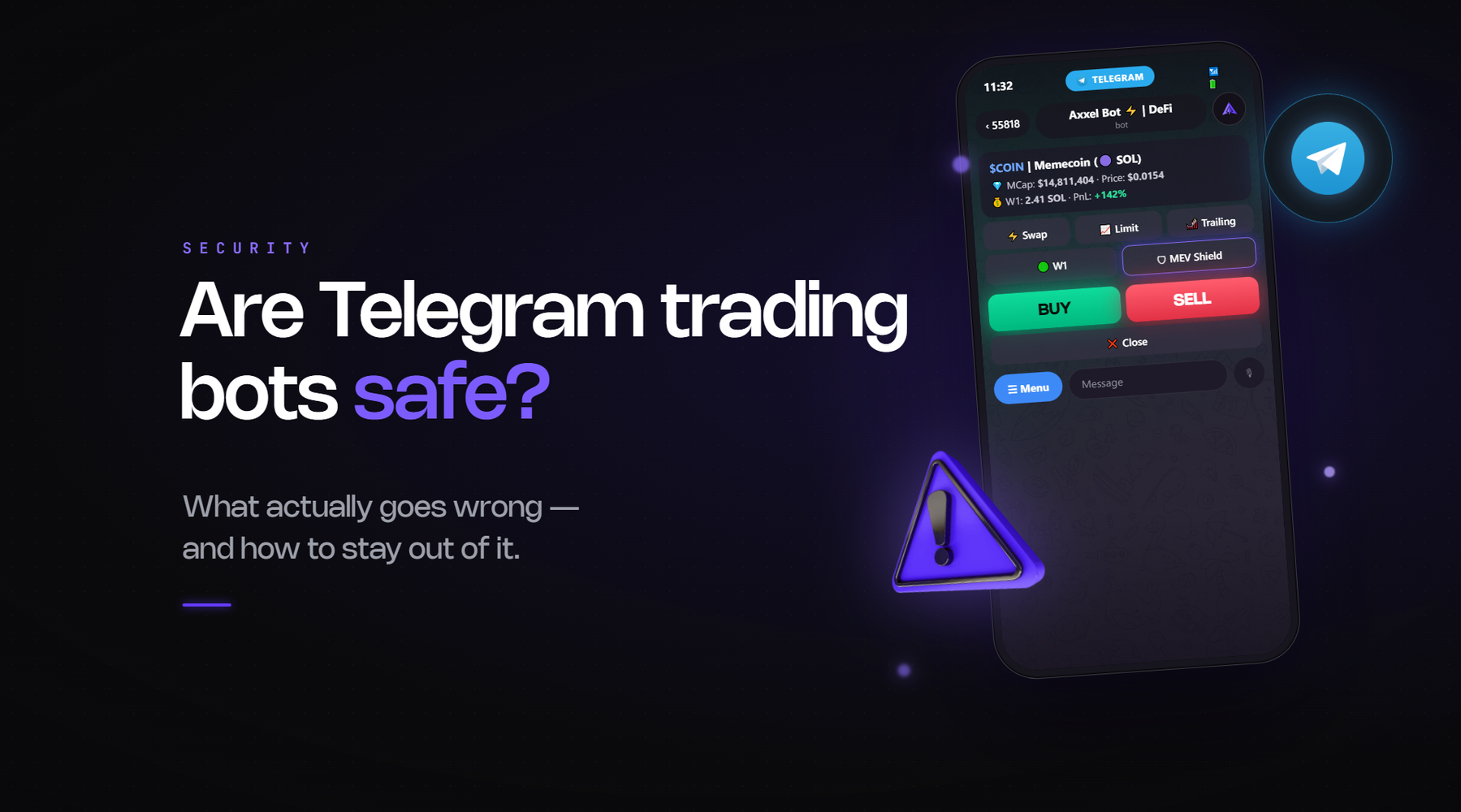
Are Telegram Trading Bots Safe? What Actually Goes Wrong
The honest answer, including the risks that aren't the ones you're worried about.

Merlin
Author
We build one of these, so read this accordingly. But a piece that just says "yes, completely safe, please sign up" would be useless to you and dishonest of us, so here's the actual answer.
Telegram trading bots are reasonably safe when you pick a decent one and use it sensibly. The risks are real but they're mostly not the ones people ask about. And the biggest risk by a wide margin has nothing to do with the bot at all.
Let's go through it properly.
The risk that actually gets people: fake bots
This is the number one cause of losses associated with trading bots, and it isn't a bot failing. It's someone using the wrong one.
There are fake Telegram bots impersonating every popular trading bot. Near-identical usernames, copied interfaces, cloned welcome messages. They circulate through DMs, through comments on posts about the real bot, and through search results inside Telegram itself. You start the bot, it generates a wallet or asks you to import one, you fund it, and the funds are gone.
Nothing sophisticated happened. You used a different product than the one you meant to use.
The protection is boring and absolute: only ever open a bot through a link from the project's official website or verified account. Not a DM. Not a comment. Not a Telegram search result. Bookmark the real one and use the bookmark every time. If you're ever unsure, close it and navigate from the website again — it costs you ten seconds.
This is the same category of problem as how wallets get drained generally, and the same discipline solves both.
Key storage: the question that separates them
Almost every serious trading bot is non-custodial, so that word alone doesn't tell you much. What varies enormously is what's actually happening with your private key underneath it.
Some bots hold encrypted keys in their own application database. Some use dedicated key-management infrastructure with hardware-backed isolation. Both get described the same way in marketing copy. They are not the same risk.
The sharpest test is whether you can export your private key. If you can, the bot is a convenience layer over a wallet you genuinely own, and you can leave whenever you like. If you can't, you're dependent on that platform continuing to exist and function in order to reach your own money.
We've gone through this in more depth in what non-custodial actually means, including what to ask before depositing anywhere. It's the single most useful thing to check and it takes about a minute.
Platform exploits: they happen, and the response matters more than the incident
Trading bots have been exploited. In 2023, roughly $1.1 million was lost across the Maestro and Unibot incidents. Earlier, the 3Commas API key leak affected 44 verified victims to the tune of about $14.8 million.
Nobody should pretend this category has a clean record.
What's more informative than whether a platform has had an incident is what happened next. Maestro refunded affected users in full within hours, which is genuinely the best response in the category and worth more as a signal than never having been tested.
The practical takeaway isn't to avoid bots. It's to hold what you're actively trading in your bot wallet and keep everything else somewhere it isn't exposed to any platform's code.
Platform disappearance: the risk almost nobody prices in
In June 2026, BullX disabled trading. Not a hack, not a rug — the team paused the product and pointed at a future version with no timeline. Withdrawals and wallet functions kept working, so nobody lost funds. But anyone with open positions became a spectator, and the points balances people had farmed for months went into limbo.
That's the failure mode worth thinking about. Self-custody protects your assets; it doesn't protect your ability to use them. If a platform is your only route to your wallet, its downtime is your downtime — whether that's a permanent shutdown or a thirty-minute outage during a volatile candle.
Which loops back to the export question. If you can move your key elsewhere, a platform going dark is an inconvenience. If you can't, it's a problem. There's more on the practical fallout in our BullX alternatives piece.
The risk that dwarfs all of the above
Here's the part that gets lost in these discussions.
Add up everything above and it's still small compared to the actual thing that loses people money in this space, which is the tokens they buy.
The overwhelming majority of memecoins go to zero. Most within days. That happens whether you bought through a bot, through Uniswap, through a wallet swap, or by carrier pigeon. The bot is an interface — it doesn't change the base rate of what you're trading.
So the honest framing is: worrying about whether the bot will steal your money while aping into unverified contracts with 40% slippage is worrying about the wrong thing by an order of magnitude. The rug pull checks matter far more than which interface you place the trade through.
What to actually check before using one
- Get the link from the official site. Every time. This one prevents most real-world losses.
- Can you export your private key? Test it with a small amount before committing anything meaningful.
- Does the platform state clearly that it can't access your funds, and does its documentation explain the architecture? Vague reassurance isn't an answer.
- What's the incident history, and how did they handle it?
- Use a dedicated wallet. Trading balance only, nothing you'd hate to lose.
- Never share your seed phrase. No legitimate bot, support account or moderator will ever ask. Anyone asking is attacking you, regardless of how convincing they seem.
Where we stand
Axxel is non-custodial, built on Turnkey's key infrastructure — enterprise key management rather than keys sitting in application storage. We can't access your funds and we can't access your private keys. That's architectural, not a policy we could quietly change.
We're also not going to tell you that makes us risk-free. Use a separate wallet. Only ever open the bot from axxel.ai. Keep a backup of your key somewhere offline. Do that with us and do it with anyone else you use — the discipline transfers, and it's worth more than any single platform's assurances.
If you want to see how the options compare on custody, fees and chain coverage, there's a side-by-side in our rundown of the main Telegram trading bots.
Crypto trading carries risk. Most memecoins lose value. Nothing here is financial advice. Axxel is not available in all regions.