How to Stop Revenge Trading Memecoins
The loss isn’t what ends most accounts. It’s the next three trades. Here’s what revenge trading actually is, how to recognise it in the first five minutes, and the rules that make it mechanically impossible

Merlin
Author
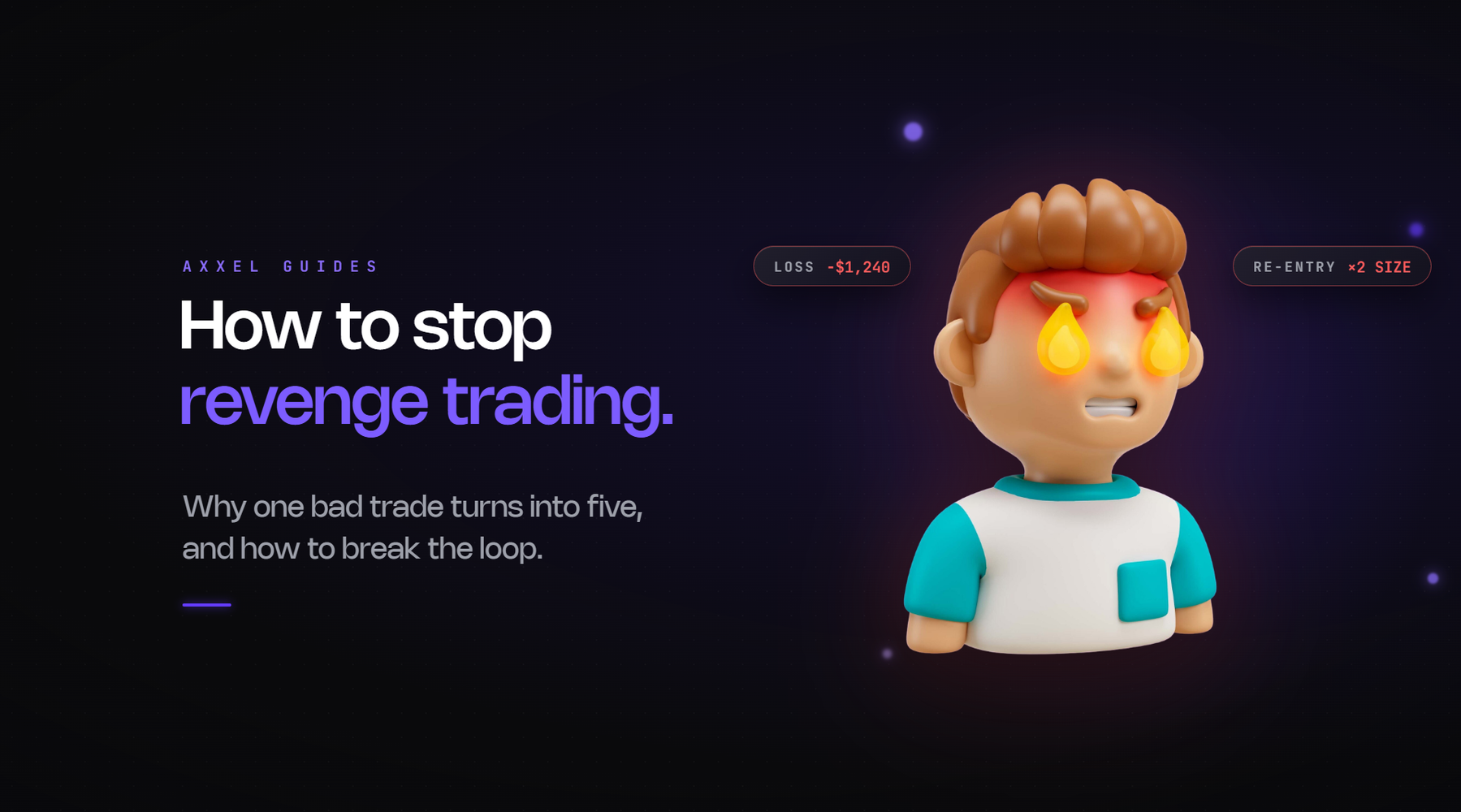
You take a loss. It stings more than the number justifies. Twenty minutes later you’re in a token you didn’t research, sized bigger than your usual, because the loss “needs” to come back before you can stop.
That’s revenge trading. It’s the most common way a bad trade turns into a bad week, and the people it catches most are the ones who’ve been doing well, because a loss feels like an insult when you’re used to winning.
What it actually is
Revenge trading is any trade taken to undo a feeling rather than to take an opportunity. The tell is in the sizing and the speed: bigger than normal, faster than normal, with less research than normal, usually within an hour of a loss.
The brain treats a loss as a debt the market owes you. It doesn’t. The market has no memory of your last trade and no interest in making you whole. But the urge to “get back to flat” is strong enough that people will take a worse trade with more money to chase a number that only exists in their head. Why you keep losing is very often this one behaviour on repeat, dressed up as bad luck.
The signs you’re in it right now
You’re sizing up after a loss instead of down.
You’re in a token you first heard of less than ten minutes ago.
You’ve said “just one more” or “I’ll stop when I’m back to even.”
You’re checking the chart more often than you were an hour ago.
You’ve skipped the checks you’d normally do, because doing them would take time and the feeling won’t wait.
Any two of those and the next trade is a revenge trade, whatever story you’re telling yourself about it.
Why memecoins make it worse
Three things. Trades settle in seconds, so there’s no natural cooling-off period between the loss and the next entry. The market is open 24 hours, so there’s no bell to save you. And the volatility means a revenge trade can lose 50% in minutes, which triggers the next one. It’s a loop with no friction in it, which is why whether this is trading or gambling is a fair question, and the answer depends mostly on whether you have rules that hold when you’re upset.
Five rules that make it mechanically impossible
Willpower in the moment doesn’t work. The version of you that takes revenge trades is not the version of you reading this. So the rules have to be set now and executed without your permission later.
1. A daily loss limit, in writing. Decide a number, something like 5% of your trading bankroll, that ends the day when it’s hit. Not “I’ll be careful.” Ended. Close the terminal. The number is set when you’re calm so it can’t be renegotiated when you’re not.
2. Size down after a loss, never up. Your next position after a loss is half your standard size, until you’ve had two normal trades. That rule alone removes most of the damage, because revenge trading needs size to work. Position sizing is the whole defence here.
3. A 30-minute gap after any red trade. No new entries for half an hour after a loss. The feeling fades faster than you’d expect, and most revenge trades happen in the first fifteen minutes. If the opportunity is still there in 30, it was real. If it isn’t, it wasn’t.
4. Exits set at entry, every time. If the stop loss and take profit are placed the moment you buy, the trade ends on its own terms rather than yours. A revenge trade with no exit is how a bad hour becomes a bad month.
5. Two separate wallets. A trading wallet with this week’s budget, and everything else somewhere the terminal can’t reach. When the trading wallet is down to your limit, there’s nothing to revenge trade with. Multi-wallet setup is usually explained as an organisation tool. Its best use is as a wall between you and yourself.
What to do with the urge instead
Write the trade down. The loss, what you got wrong, and what you’re feeling. It sounds soft; it works because it moves the loss from your gut to a page, and most people find that the urge to re-enter drops sharply once the trade exists in writing. Half the point of a trading routine is having somewhere to put this.
Then do something physical for the length of the gap. Not another chart.
When it’s bigger than a bad week
If the pattern is daily, if the loss limit gets ignored more than it’s kept, or if you’re trading to feel something rather than to make money, that’s beyond discipline and the honest version of that conversation is here. There’s no shame in it and plenty of people in this market are closer to it than they’d say.
Axxel supports stop loss, take profit, limit and trailing orders across Ethereum, Base, BSC, Solana and Robinhood Chain, so the exit can be set before the emotion arrives, and multiple wallets so the trading budget stays separate from everything else. Flat 0.9%, non-custodial, no subscription.
The loss was one trade. The revenge is the thing that ends accounts.
Crypto trading carries risk. Most memecoins lose value. Nothing here is financial advice. Axxel is not available in all regions.