Is Crypto Trading Addictive? An Honest Answer
It's built like a slot machine and it lives in your pocket. Here's why it grips, how to tell if it has, and what actually helps.

Merlin
Author
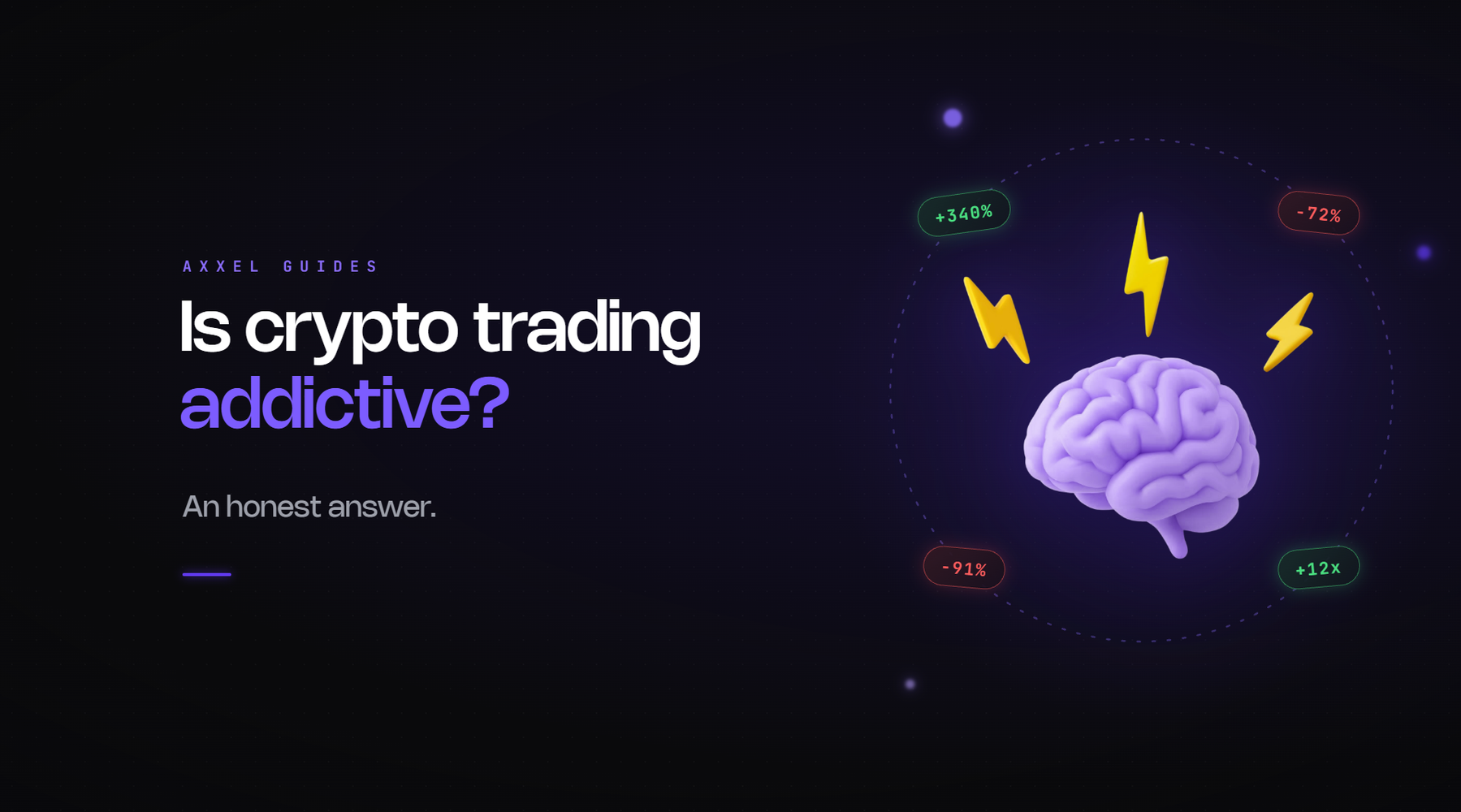
Yes, it can be. Not for everyone, and not in a way that makes trading itself the problem, but the honest answer is that memecoin trading has every design feature that makes something compulsive, and almost nobody in the industry says so out loud because the industry earns on volume.
This is worth reading even if you're sure it isn't you. Most people who'd answer "no" would also admit to checking a chart at a moment they shouldn't have.
Why it grips
Variable rewards. Most trades lose, some win, and occasionally one wins enormously. That's the exact reward schedule slot machines use, because it's the one the brain finds hardest to walk away from. A predictable reward gets boring. An unpredictable one doesn't.
It never closes. Stock markets shut. Casinos are somewhere else. This is on your phone at 3am, and the time zone piece covers how the market's rhythm turns into yours.
Near misses. A coin you looked at and didn't buy goes 50x. Nothing happened to you, and it feels like a loss. Near misses drive continued play more reliably than actual wins do, and memecoins produce them constantly.
Instant, frictionless, small. No forms, no waiting, no minimum. Twenty dollars in three taps. The friction that stops most people gambling more than they meant to has been engineered out.
Social reinforcement. The group chat, the timeline, the PnL screenshots. Everyone around you is doing it, and the culture treats the compulsive version as a personality rather than a problem.
Signs it's tipped over
None of these is a diagnosis. They're the markers people describe once they've come out the other side.
Checking charts at moments that matter, and not being able to stop. Trading money that was for something else. Hiding the amounts, the frequency, or the losses from people who'd care. Sizing up after a loss to get back to where you were. Mood that tracks a number you don't control. Deciding to stop for the day and not stopping. Sleep gone, appetite off, relationships thinner.
If several of those are familiar, the useful response isn't shame. The mechanism is designed to do this, and it works on plenty of people who are otherwise fine.
The distinction that matters
Trading with a process and trading compulsively can look identical from outside. The difference is who's in charge of the decision.
A process means the exit was decided before entry, the size came from a rule, and the trade happens whether you feel like it or not. Compulsion means the trade happens because you feel like it, and the rules get rewritten in the moment. Is memecoin trading gambling covers the same line from the other side.
What actually helps
Structure, not willpower. Willpower is the thing the reward schedule is built to beat.
Orders instead of watching. If the exit is set, there's nothing to watch. Most compulsive checking is the absence of a plan.
The app off the home screen, notifications off. Not deleted, just harder. Friction back where it was removed.
Fixed sittings. The daily routine is three short windows and a closed tab in between. The point of it is that trading has edges.
A walled bankroll. Money that's for this and only this, in one place, and nothing else touches it. When it's gone it's gone, and there's no topping up from the rent.
A log. Writing down every trade and what you were feeling when you took it. Reading it back is the most effective mirror there is.
A week off. If you can't take one, that's the answer to the question in the title.
Telling one person. Not the whole internet. One person who'll ask how it's going and mean it.
When it's past that
If you've genuinely tried the structural fixes and can't hold to them, this is a gambling problem in a different costume, and it deserves to be treated like one. Gambling support services in most countries now handle crypto, and talking to one costs nothing and commits you to nothing. There's no version of this that gets better by being ignored, and it's the kind of thing that gets worse quietly.
Where a platform sits in this
Most trading tools are built to maximise trades, because trades are revenue. That's not a conspiracy, it's the model, and it's why nothing in the category nudges you to slow down.
We'd rather have someone trading sensibly for years than trading compulsively for a month and disappearing. Axxel's orders, stop loss and take profit exist so the plan can execute without you watching, and the token analysis exists so the checks don't depend on remembering to do them. Across Ethereum, Base, BSC, Solana and Robinhood Chain, flat 0.9%, non-custodial, no subscription.
The tool can hold the structure. It can't decide you need one. That part's yours, and it's worth deciding before the market decides for you.
Crypto trading carries risk. Most memecoins lose value. Nothing here is financial or medical advice. If you're struggling with compulsive trading or gambling, support services in your country can help and are worth contacting. Axxel is not available in all regions.