A Daily Routine for Memecoin Trading (That Doesn't Eat Your Life)
Ninety minutes, three sittings, and a hard stop. Here's what a sustainable day actually looks like.

Merlin
Author
The default way to trade memecoins is to have a screener open in one tab, Telegram in another, and X in a third, and to react to whatever moves. It's exhausting, it produces terrible decisions, and almost everyone does it.
Here's the alternative. Not because structure is virtuous, but because most of the expensive mistakes happen in the gaps between sittings, when you're watching but not thinking.
The principle
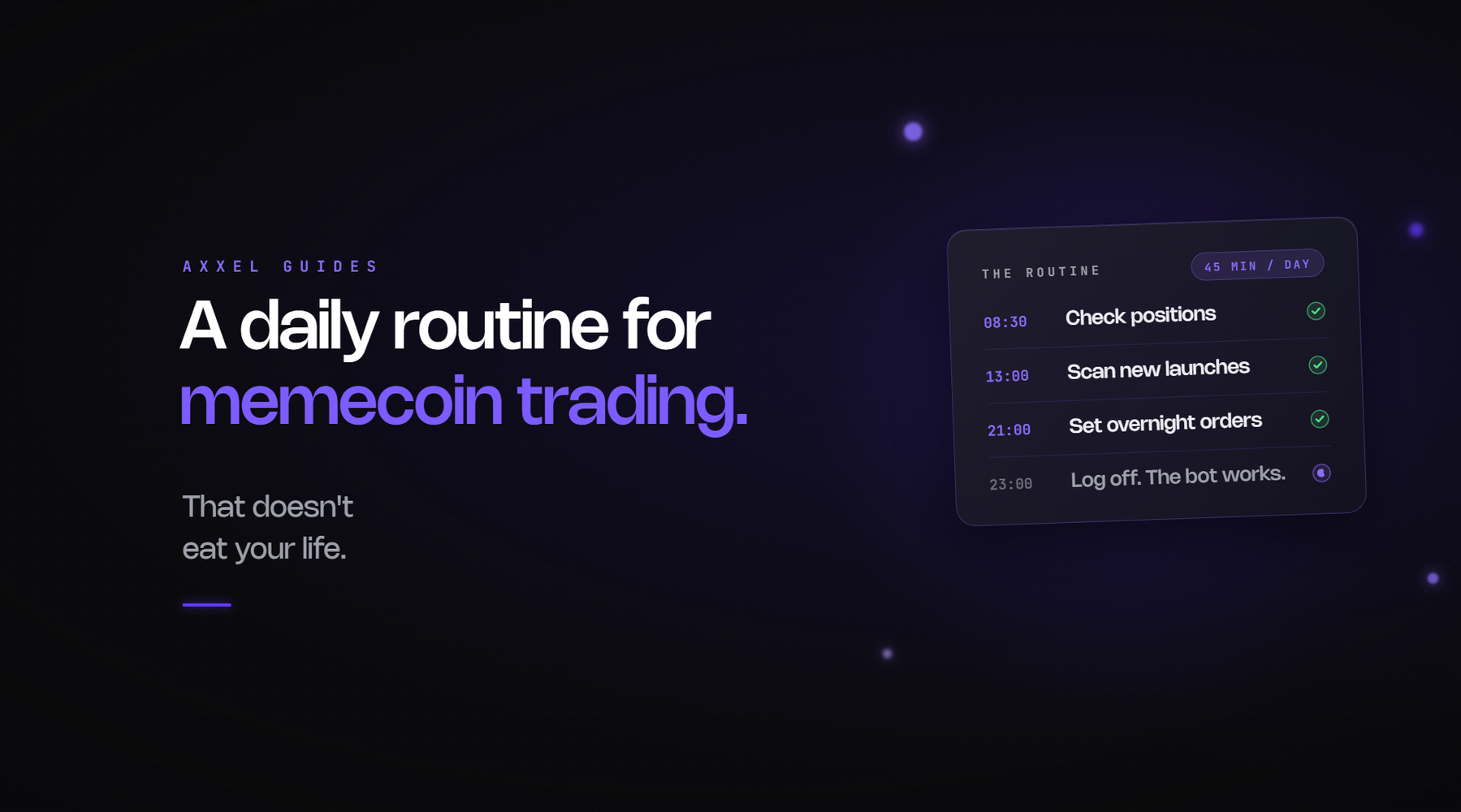
Three short sittings beat one long one. Each has a specific job. Between them, the tab is closed and orders are doing the work.
That last part is the whole thing. If you're relying on being present to manage exits, you're relying on the version of you that's been staring at a chart for six hours. Set the orders, then leave.
Morning: twenty minutes
Positions first. What happened overnight. Which orders filled, which are still resting, what's moved. Check holder count and volume on anything you're in rather than just price, since those tell you whether the thing holding the price up is still there. The full list is in managing a memecoin position.
Then the meta. What's trending, on which chain, and is it new or the tail of yesterday. Ten minutes across a screener and whatever accounts you trust. You're looking for rotation, not individual coins.
Then decide the day's budget. How much you're willing to deploy today, in total, across everything. Fixed before you've seen anything exciting. This number is the single most protective thing in the routine.
Close the tab.
Midday: thirty minutes
This is the research sitting, and it's the only one where you're looking for new things.
Run your saved screener filters. Anything that passes the floors gets the five-minute routine. Most won't survive it. The ones that do, you either take a position sized against the day's budget with exits set at entry, or you add to a watchlist with an alert and move on.
Two rules. Nothing gets bought without exits placed in the same sitting. And nothing gets bought because it's already moved, since that's the chasing pattern and it's the one that costs the most.
Close the tab.
Evening: twenty minutes
Review, not trade. What filled, what didn't, and why. Whether any thesis has broken. Whether anything you're holding has had its narrative catalyst pass without a replacement.
Adjust orders if needed. A position that's now in profit might warrant converting a fixed stop to a trailing one. A position whose reason for existing has gone should close, and this is the sitting where you'd notice.
Log it. One line per trade: what, why, size, exit plan, outcome. Not for tax, for you. After a month the log tells you which of your ideas actually work, which is information you can't get any other way.
Close the tab. That's the day.
What runs between sittings
Orders. Alerts on price levels and holder thresholds that matter. Nothing else.
If something moves hard while you're away and you didn't have an order or an alert on it, that's information about your setup, not a reason to react. Fix the setup tomorrow.
The hard stop
When the day's budget is deployed, you're done buying. Not done watching, done buying. Anything you see after that goes on the watchlist for tomorrow.
The budget is the mechanism that stops one good morning turning into an oversized afternoon. Without it, every routine collapses the first time something runs.
What this deliberately excludes
Constant chart watching. Group chat monitoring. Reacting to every cosign. Refreshing a screener between sittings. All of it feels like trading and none of it improves outcomes. The psychology piece covers why watching makes decisions worse rather than better.
Launch sniping is also mostly outside this routine, since it's reactive by nature. If that's part of what you do, it's a separate discipline with its own rules, covered in how to snipe a token launch, and it should have its own separate budget.
Adjusting it
Ninety minutes is a starting point. Some people run this in an hour, some want two. The shape matters more than the timing: separate sittings with separate jobs, orders doing the work in between, a budget that ends the buying, and a log that tells you what's working.
The people who last in this market are rarely the ones who watch it most. They're the ones who decided in advance what they'd do, set it up, and got on with their day.
Axxel supports market, limit, trailing and sniper orders, stop loss and take profit, price alerts and position tracking across Ethereum, Base, BSC, Solana and Robinhood Chain. Flat 0.9%, non-custodial, no subscription. The orders and alerts are what let the routine work when you're not there.
Crypto trading carries risk. Most memecoins lose value. Nothing here is financial advice. Axxel is not available in all regions.