Trading Across Time Zones: When Memecoin Activity Actually Happens
The market runs 24/7. The people don't. Here's when things move and why.

Merlin
Author
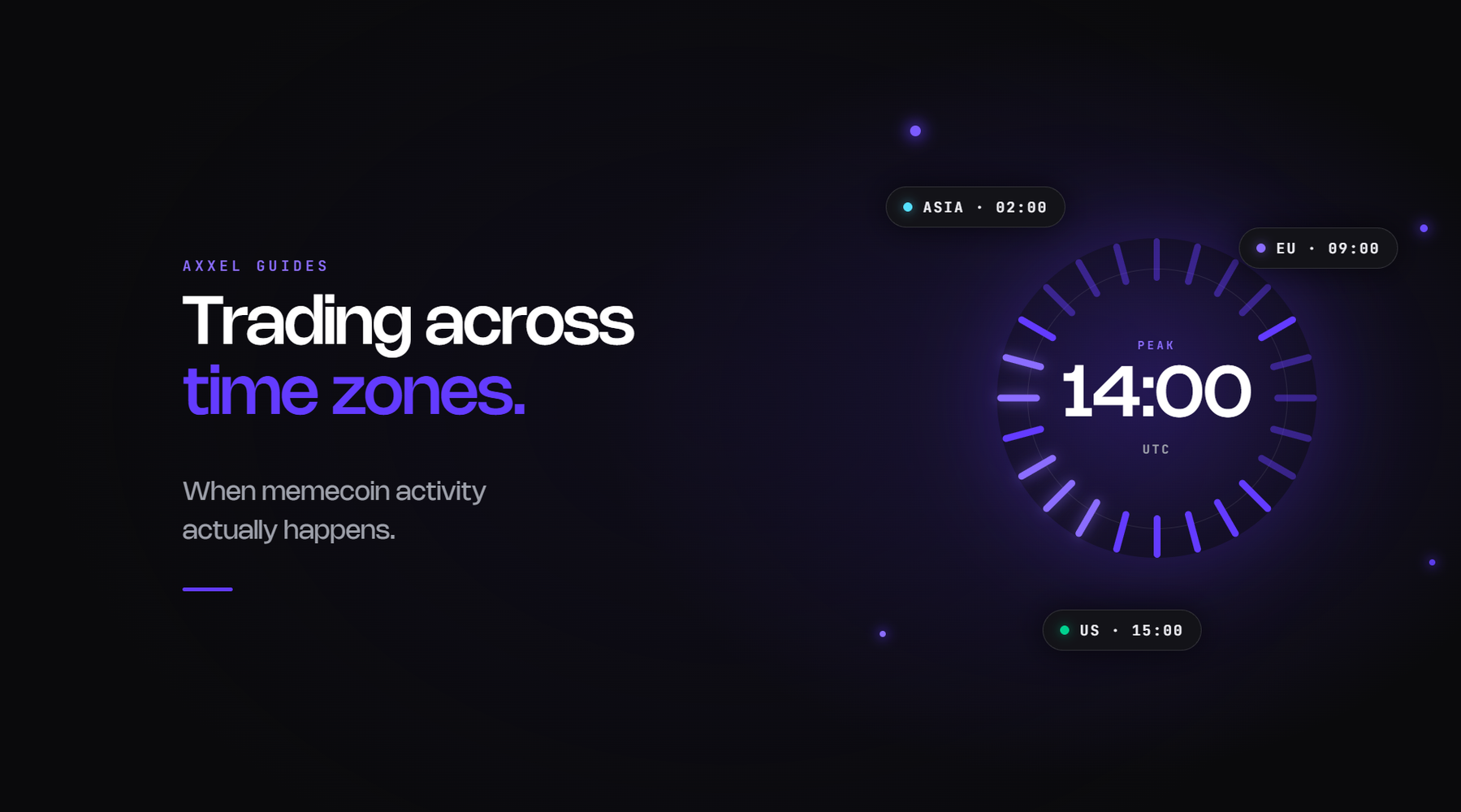
Crypto never closes, which people take to mean the activity is evenly spread. It isn't. Volume, launches and volatility all cluster around specific hours, and knowing the rhythm changes when you bother to look.
The rough shape of a day
All times UTC.
00:00 to 06:00. Asian hours. This is when BNB Chain is most active, since a large share of its memecoin community is Chinese-speaking. Things that run here are frequently discovered by English-language CT six hours later, at a considerably higher price.
06:00 to 12:00. European morning. Generally the quietest stretch for memecoins. Thin liquidity, wider spreads, and a decent time to place limit orders that nobody's competing for.
12:00 to 16:00. The overlap. European afternoon meets the US waking up, and this is where volume starts building properly across most chains.
16:00 to 00:00. US hours, and the busiest window for Solana, Base and Robinhood Chain. Most launches that go anywhere, most volume, most volatility. If something's going to run, it usually runs here.
That's a generalisation and any individual token ignores it entirely. But across enough days the pattern holds.
Why this matters practically
Liquidity varies with the clock. The same token has thinner pools at 04:00 UTC than at 20:00. Thinner pools mean more price impact on the same order size, so a position that fills cleanly in the evening can fill badly overnight.
Slippage settings that work in one window fail in another. A tolerance tuned for active hours will often fail to fill during quiet ones, and a tolerance set wide enough for quiet hours is an invitation during busy ones. More on the trade-off in what is slippage.
Launches cluster. Deployers launch when there are people around to buy. Which means the quiet hours have fewer launches and a higher proportion of bots among the buyers.
Your edge is being awake when others aren't, or automated when you aren't. Those are the only two options, and the second scales better.
The weekend effect
Volume drops across most chains, but volatility often doesn't. Thinner books with the same news flow means moves are sharper in both directions. A token that would absorb a large sell on a Wednesday can gap on a Sunday.
Weekends are also when a disproportionate number of rugs happen, for the obvious reason that fewer people are watching and the response is slower.
The stock-paired exception
Worth a separate mention because it's specific to Robinhood Chain and it catches people out.
Stock-paired memecoins are quoted against tokenised equities, and those equities track real stocks that only trade during US market hours. When the underlying market is closed, the stock token's spread widens because whoever's providing that liquidity is carrying risk they can't hedge.
So the memecoin trades 24/7 while its quote asset effectively goes part-time. Execution outside US market hours is generally worse, and part of a weekend price move in one of these can be the stock token's spread rather than anything about the memecoin.
This has already had a real-world consequence: speculative demand for one stock-paired memecoin drove trading in the underlying tokenised stock while US markets were closed, which flowed through to the actual shares and started a public dispute between the companies involved.
If you trade these, US market hours are the better window, and it's not a small difference.
What to do with this
Set orders rather than watching. The whole point of limit orders and trailing stops is that they work at 04:00. If your strategy requires you to be present, your strategy has a time zone problem. The daily routine piece covers a structure that doesn't.
Match the chain to your hours. If you're in Europe and awake during Asian hours, BNB Chain is where the information asymmetry is. If you're up in the US evening, Solana is where the action is.
Widen your expectations overnight. Fills will be worse, spreads wider, and moves sharper. Size accordingly rather than assuming the conditions you know.
Don't fight your own schedule. Trading badly at 3am because you felt you had to be there is how people lose money and sleep in the same session.
Axxel supports limit, trailing and sniper orders, stop loss and take profit across Ethereum, Base, BSC, Solana and Robinhood Chain, so positions can be managed while you're asleep rather than requiring you not to be. Flat 0.9%, non-custodial, no subscription.
The market runs constantly. You don't have to.
Crypto trading carries risk. Most memecoins lose value. Nothing here is financial advice. Axxel is not available in all regions.