How to Buy Pump.fun Tokens With a Trading Bot
The curve, the graduation, and why the same token is a different trade either side of it.

Merlin
Author
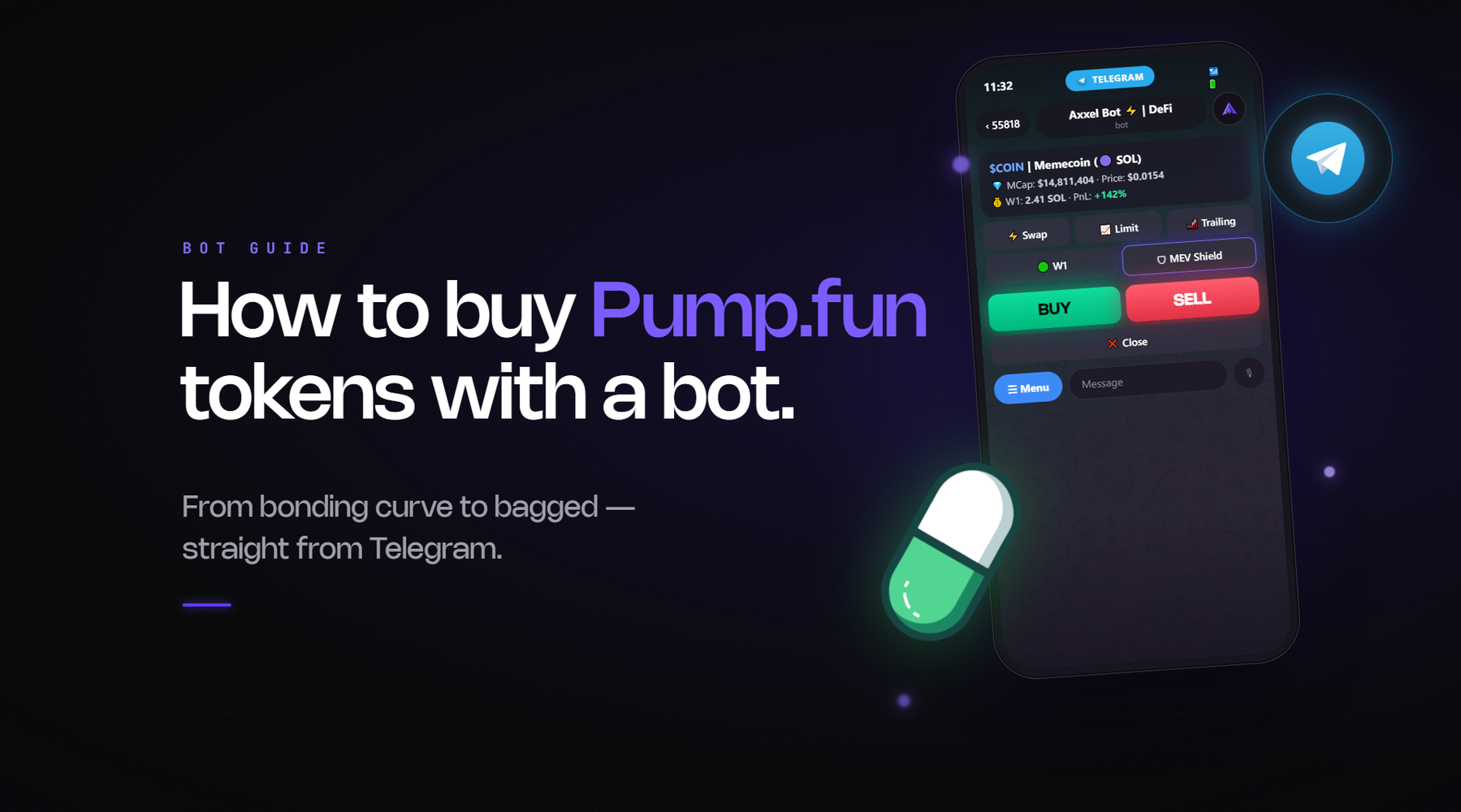
Most Solana memecoins start life on pump.fun. Deploying one takes about thirty seconds and buying one takes less than that.
That accessibility is the whole point of the platform, and it's also why only a small fraction of tokens created on it ever make it off the launch curve. The overwhelming majority die within hours of existing.
None of which is an argument against trading it. It's an argument for understanding what you're actually buying, because a pump.fun token behaves like two structurally different assets depending on which side of graduation it's sitting on.
What pump.fun is
A launchpad on Solana. One transaction deploys a token with fixed parameters — no custom supply, no custom price, no choices to make.
Every token gets a one billion supply. Most of that goes into the bonding curve and is what's available to buy pre-graduation. The remainder is held back to seed a liquidity pool later.
The structurally important part: there is no liquidity pool at launch. Nothing to pull, nothing to check, no LP to lock or burn, because none exists yet.
You're buying a curve, not a pool
Pre-graduation, there's no counterparty and no order book. You're trading against a formula.
Every buy deposits SOL into the contract and moves the price up along a fixed mathematical curve. Every sell moves it back down the same way. The price at any moment is a direct function of how much has been bought so far — which means it's deterministic, and it means being early is mechanically better rather than just narratively better. The full mechanics are in what is a bonding curve.
The useful practical consequence: because the curve is a formula, your price impact is computable before you trade. You can work out exactly what a given size costs you. That's rarely true anywhere else.
Graduation, and what changes
When enough SOL has gone into the curve, the token graduates. Trading on the curve stops and the token migrates to pump.fun's own AMM. Check pump.fun's own documentation for the current threshold, since the parameters have been revised more than once.
At that point the accumulated SOL plus the reserved tokens seed a real liquidity pool, and the LP is burned. So for graduated tokens, the classic rug of someone withdrawing the liquidity is off the table at that specific step.
What is not off the table: the deployer's own holdings, and anything a connected cluster accumulated on the curve. Burned LP means the pool can't be removed. It says nothing about who's holding the supply above you.
Post-graduation you're in a normal pool and normal rules apply — read the liquidity against the market cap the way you would with any other token.
The base rate, said plainly
Only a small share of tokens graduate. Thousands launch daily and attention is spread across all of them, so most never attract enough buying to clear the threshold before the next wave takes the spotlight.
There's also a self-defeating dynamic: early buyers taking quick small profits sell back into the curve, which reduces the accumulated balance and pushes graduation further away. Bots that buy in the first blocks and exit on a small move do this at scale.
What follows from that isn't "don't trade it", it's size accordingly.
Buying from the site versus buying from a bot
From the site, it's connect a wallet and buy. Fine for a casual position and there's nothing wrong with it.
Where a bot earns its place is everything around the trade rather than the trade itself:
Speed. On a launch, the first blocks decide your entry price. A bot with presets configured executes in one action; a browser wallet is several.
Presets. Slippage, priority fee and size set in advance rather than typed under pressure, so your execution is the same at 3am as it is when you're calm.
Exits set at entry. You can place the sell at the same moment you take the position, which is the single biggest behavioural fix available — when you sell stops being a decision you make while emotional.
MEV protection. Relevant on any chain where your transaction is visible before it lands, and sandwich bots are most active on exactly the thin, fast-moving pools you're trading here.
Separate wallets for separate positions, rather than running everything from one address.
No extension, no tab switching. If you're on your phone, this is most of the value on its own.
Before you pick one, read what non-custodial actually means and whether Telegram bots are safe, because custody is the thing that genuinely differentiates them and most people never check it.
Sniping launches
You can set a bot to buy the moment a token deploys.
The honest version of this: you are entering a race against other bots, and the setup is the whole game. Priority fees decide whether your transaction lands in the block you wanted, slippage tolerance decides whether it fills at all, and getting either wrong means you either miss or you fill at a price you didn't intend.
Sniping also front-loads your risk. You're buying before there's any holder distribution to read, any volume to judge, or any behaviour to observe. That's the trade-off: the best entry price on the curve, and the least information you'll ever have about what you just bought.
The checks that fit before you buy
On the curve there's less to check than usual, which cuts both ways.
Get the contract address from the project's own channel. Never from a search. Ticker collisions on pump.fun are constant and some of them are deliberate.
Look at how far along the curve it is. Near-zero progress is a different proposition to eighty percent, both in upside and in likelihood.
Check holder concentration and whether the top wallets look connected.
Look at whether anything exists beyond the token — an account, a community, a reason for the thing to be bought by someone who isn't you.
Post-graduation the full set applies: the rug pull checks, and reading the pair properly once there's a pair to read. If you're working the new-launch feed daily rather than dipping in, build it into a routine.
What it costs you
Four separate things, and people usually only think about one.
Pump.fun takes a cut of trades on the curve, and a smaller cut post-graduation on its own AMM. These percentages have been revised more than once, so check the current figures on pump.fun's own documentation rather than trusting any explainer, including this one.
Priority fees, which are what get your transaction included promptly and are almost invisible to the people paying them.
Your bot's trading fee, which varies more than you'd expect between platforms.
And the cost that isn't a fee at all — the gap between the price you saw and the price you got.
Decide the exit while you're calm
The failure mode on pump.fun isn't usually getting rugged. It's picking something that runs, watching it run further, and riding it all the way back down because selling at 4x felt premature at 9x.
Set the exit at the same time as the entry. A limit sell for a fixed target, or a trailing stop if you'd rather not guess the top — that one lets it run as far as it wants and takes you out on a set giveback from the high.
Axxel runs on Ethereum, Base, BSC, Solana and Robinhood Chain with token analysis, configurable slippage and tax limits, MEV protection, snipe orders, and limit and trailing orders. Telegram is the main access point today. Flat 0.9%, non-custodial, no subscription.
The curve rewards being early and punishes being slow to leave. Both halves of that are execution problems, and both are solvable before you're in the trade rather than during it.
Crypto trading carries risk. Most memecoins lose value. Nothing here is financial advice. Axxel is not available in all regions.