How to Read a KOL Cosign: Signal, Paid Promo, or Exit Liquidity?
The most common single-day catalyst in memecoins, and the three things it can mean.

Merlin
Author
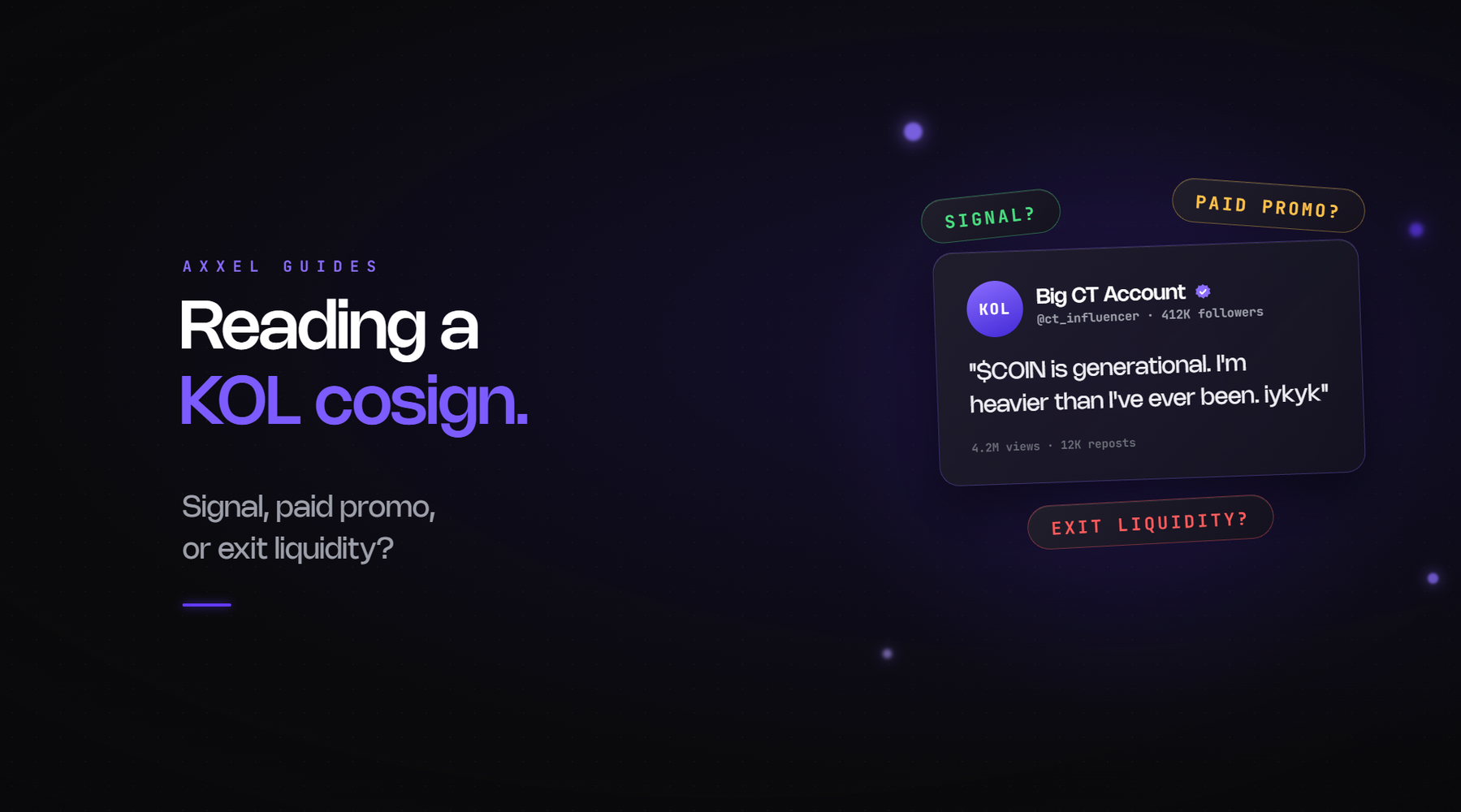
A single post from the right account can take a token from $2m to $30m in a day. It's the most reliable catalyst in memecoins and the least examined, because by the time you're evaluating it, the price has already moved.
Here's what a cosign can actually be, and how to tell which one you're looking at.
The three kinds
Conviction. They bought it, they like it, they said so. The post is a genuine opinion from someone whose opinions move markets.
Paid promotion. They were compensated to post it, in tokens, cash, or a fee share. Legal in most places if disclosed. Frequently undisclosed.
Exit liquidity. They bought earlier, the post brings buyers, they sell into them. The wallet's record still looks good afterward, because it did make money. The people who bought the post provided it.
All three look identical from the outside. The differences are on-chain.
Five things to check
1. Did they buy before or after posting? Pull their wallet, if it's known, and look at the timing. Buying at $2m and posting at $8m is one thing. Buying at $8m and posting at $8m is a different kind of endorsement. Buying nothing at all is a third.
2. Are they still holding? The single most informative check. If the wallet is selling into the pump the post created, you've got your answer. If it's holding a week later, the post was closer to conviction.
3. What's the track record? Not follower count, the actual history. How many cosigns, how many worked, and what happened to the ones that didn't. Some accounts are right often enough to be worth watching. Many post twenty tokens a week and get credit for the two that ran.
4. Is there a disclosure? Some jurisdictions require it. Most posts don't have one. Absence doesn't prove it's unpaid, but presence tells you something, and an account that discloses when paid is one you can read more clearly when it doesn't.
5. What's the volume-to-holder ratio after the post? Real conviction from a real audience brings new wallets. A paid push tends to bring volume without holders, or holders who leave within hours. The wash trading signature shows up here too.
The timing problem
By the time you see the post, three groups have already acted: the KOL, their inner circle who saw it first, and the bots watching their wallet. You're fourth at best.
Which means the move the post caused is often mostly done when you arrive. Buying a cosign is buying the second half of a run, and the second half is where the first half's buyers sell.
That doesn't make every cosign untradeable. It means the trade is on whether the attention persists past the initial spike, which depends on the token more than the poster.
The reflexivity trap
A cosign raises price. The price rise gets noticed. Other accounts post about it. Each post raises the price further. Nothing about the token changed; the loop is running on itself.
That loop unwinds the same way it wound. When the posting stops, the price has nothing under it. The why memecoins move piece covers the mechanism, and the useful takeaway is that a cosign-driven run needs continuous attention to sustain, and continuous attention is exactly what runs out.
When a cosign is genuinely useful
As a reason to look, not a reason to buy.
A serious account posting about a token is a prompt to run the five-minute research routine on it. If it passes, and if the on-chain checks above suggest the poster is holding rather than distributing, and if you can size it as though it's going to zero, then it's a trade like any other with a slightly better-than-random reason to exist.
If it fails any of those, the cosign was the entire thesis, and that's not a thesis.
Accounts worth watching versus accounts worth copying
A small number of accounts have genuine track records, particularly ones who post infrequently and hold what they post about. Watching what they buy is informative. There's more on that in how to find KOL wallets.
Copying them automatically is a different thing, and it mostly doesn't work for reasons covered in copy trading: you inherit their entries at worse prices and their exits at worse timing, without their reasoning for either.
The uncomfortable summary
The accounts that move price the most are the ones with the biggest incentive to be selling into the move. That's not an accusation, it's arithmetic. A wallet with a large position and a large audience has a mechanism for exit liquidity that a wallet with only one of those doesn't.
Treat every cosign as a claim to be checked, check it on-chain, and size the position on what the chain says rather than on who said it.
Axxel includes token analysis alongside market, limit, trailing and sniper orders, stop loss and take profit, MEV protection and configurable slippage across Ethereum, Base, BSC, Solana and Robinhood Chain. Flat 0.9%, non-custodial, no subscription.
The post is public. So is the wallet. Read both.
Crypto trading carries risk. Most memecoins lose value. Nothing here is financial advice. Axxel is not available in all regions.