Signs a Memecoin Is About to Run
The on-chain tells that show up before the candle does, and the fakes that look identical from the outside.

Merlin
Author
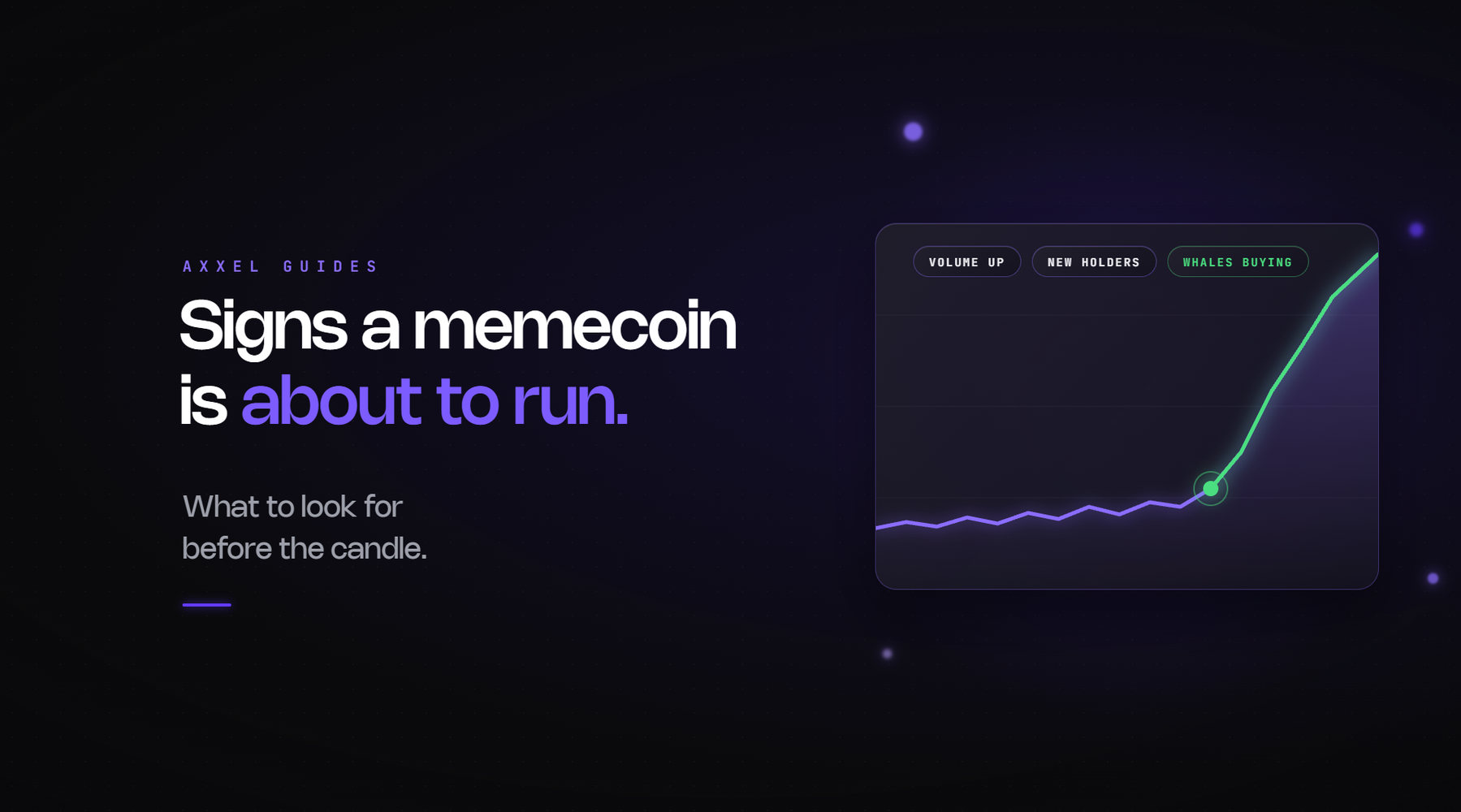
Everyone can spot a runner after the fact. The skill is spotting the set-up while the chart still looks like nothing, and that comes from the data underneath the candle, not the candle itself. This is the opposite of signs a memecoin has topped: the same tools, pointed at the start of the move instead of the end.
None of these signals work alone. Three or four together, on a coin with a reason to exist, is what you’re looking for.
1. Holders are growing faster than price
The healthiest early signal is holder count climbing while the chart goes sideways. It means new people are finding the coin and buying small, and nobody is big enough to move it yet. When price finally moves, there’s a base of holders underneath it rather than a handful of wallets.
Watch the shape of the holder distribution too. Ten new wallets each buying 1% is a different thing from one wallet buying 10%.
2. Buys outnumber sells, and the buys are getting bigger
Open the transaction feed and look at the last hour. A coin about to run usually shows steady buys, a few sells, and a slow increase in the size of the average buy. Someone is scaling in. If the buys are all exactly the same size at exactly the same interval, that’s a bot, and wash trading looks like momentum right up until it stops.
3. Wallets you track are showing up
This is the one that’s worth the most. If the smart money wallets on your list, or a KOL wallet that hasn’t posted about the coin yet, appear in the buyers before any announcement, you’re early on information rather than price. One good wallet is interesting. Three unconnected good wallets within an hour is a signal.
Check they’re real entries. Fresh wallets funded minutes earlier from the same source are a bundle, not a crowd.
4. Liquidity is deepening, not thinning
Pull up the pool. Liquidity rising alongside volume means the coin can absorb bigger buys without the price spiking, which is what lets a run keep going instead of blowing off in ten minutes. Volume rising while liquidity stays flat or falls is the set-up for a spike and a dump, not a run.
5. The dev is doing nothing
The best dev behaviour before a run is silence on the sell side. No transfers out of the dev wallet, no sells from the deployer’s connected wallets, no sudden “marketing wallet” movements. What dev sold means covers what the opposite looks like. A dev who holds through the quiet period usually has a plan for the loud one.
6. It fits a meta that’s already moving
A coin on its own needs its own catalyst. A coin inside a live meta borrows the attention of every other coin in it. When the second and third coins in a theme start running, the market goes looking for the fourth, and the one with the cleanest holder data and the most liquidity tends to get it. The same applies to a specific catalyst: a listing, a mention, a date.
7. Higher lows on no news
On the chart itself, the tell is a series of higher lows while nothing has happened. Each dip gets bought a little earlier than the last. That’s holders who’ve decided their price and aren’t selling into weakness. How to read crypto charts covers the patterns, but for memecoins this one does most of the work.
8. The chat is quiet in the right way
Attention is the fuel, but the loud version arrives late. Before a run, the signal is small: a few accounts you rate mentioning it unprompted, a Telegram group that’s been dead for a week picking up, replies on the coin’s posts from people who aren’t holders yet. When it’s everywhere, you’re in the part the first seven signals were warning you about.
The fakes
Every one of these can be manufactured. Holder growth can be airdropped wallets. Buy flow can be a bot. Smart money can be a wallet that got sent tokens for free. Liquidity can be added by the dev minutes before a dump. The defence is the same every time: check the wallets, check the funding, and if the on-chain story and the social story don’t match, trust the chain.
What to do when you see it
Size for the chance you’re wrong. A run signal is a probability, not a promise, so this is where position sizing earns its keep. Decide the exit before you enter, set a stop loss and take profit, and let the trade be boring. The traders who catch runs consistently aren’t the ones who spot the most signals. They’re the ones who survive the signals that didn’t work.
Axxel runs on Solana, Ethereum, Base, BNB Chain and Robinhood Chain, with market, limit, trailing and sniper orders, stop loss and take profit on every trade, adjustable slippage, and buy and sell tax limits that block a trade if a token’s tax is above the level you set. The fee is a flat 0.9% on every trade, and your keys stay yours.
This article is for information only and is not financial advice. Crypto assets are high risk and you can lose everything you put in.