What Does "Dev Sold" Mean? Every Label on a Token Page Explained
Dev sold, bundled, snipers, insiders, top 10. The badges on a screener, what each one actually tells you, and where they lie.

Merlin
Author
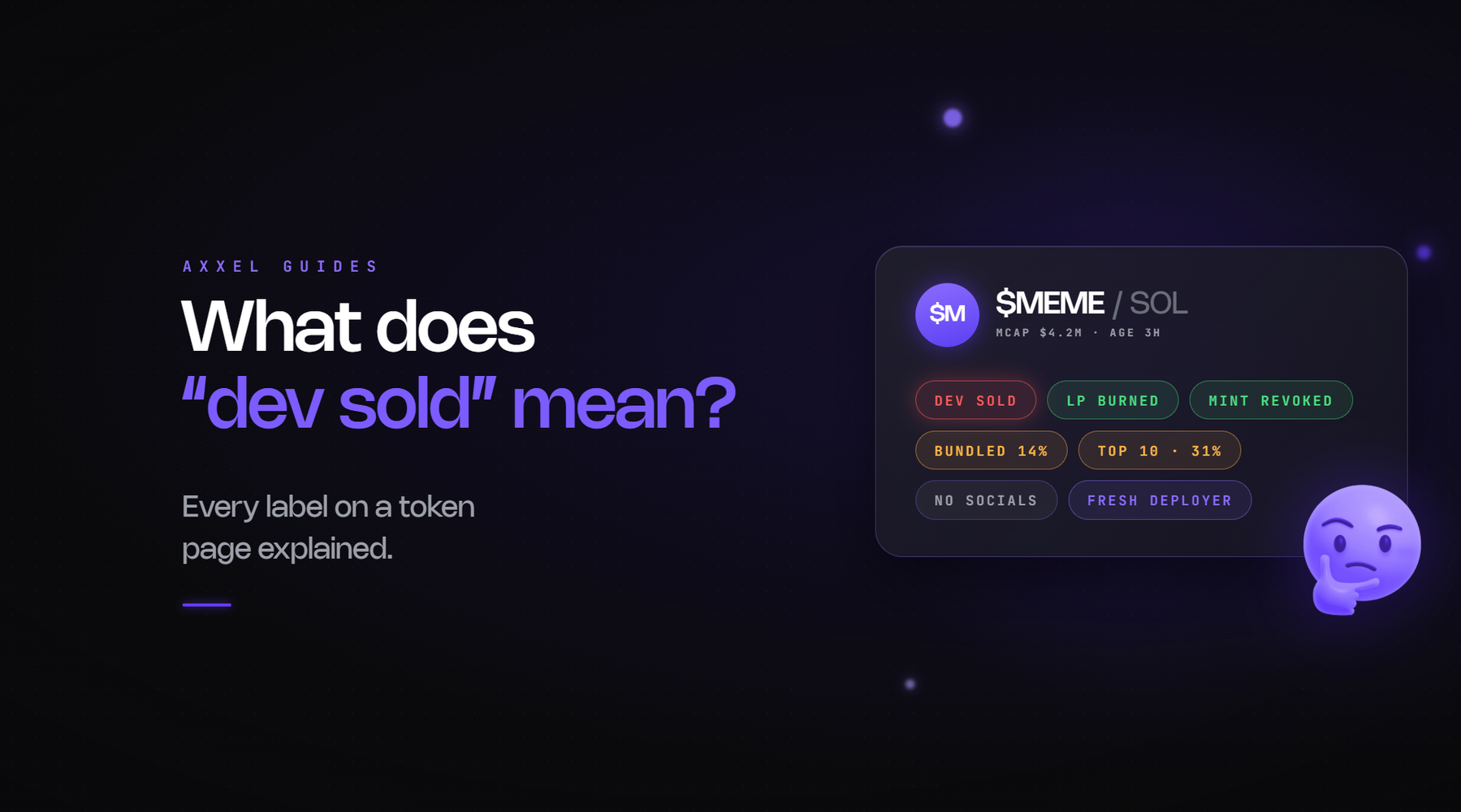
Open any new token on a screener and there's a row of labels under the name. Dev sold. Bundled 23%. Snipers 14. Top 10 holds 41%. They're useful, they're not verdicts, and most of them are a heuristic a tool applied in a few milliseconds.
Here's each one, what it's measuring, and how it misleads.
Dev sold
The wallet that deployed the token has sold some or all of what it held.
What it can mean: the operator cashed out and the token's done; the operator took a small amount for costs and is still around; or the "dev" was a fresh wallet that handed the project to someone else. All three show the same label.
What to check: how much, when, and whether it was a sale or a transfer. A deployer sending tokens to another wallet reads as "sold" on some tools and isn't. The deployer guide covers reading the wallet properly.
Sometimes devs sell to 'shake out' wallets before buying back, so it's not automatically a death sentence, but most of the time a dev selling their tokens is considered bearish.
Dev holding
The percentage of supply the deployer still has. It's overhang, and the number matters. 2% is normal. 20% is a sell waiting to happen, however nice the Telegram is.
Dev bought
On launchpads that prompt a creator buy at deployment, this shows how much the deployer bought at launch. Large relative to the curve usually means they intend to sell into you. Zero can mean a serious team that didn't want the optics, or a team that bought through other wallets instead.
Bundled
The share of supply bought in the first block by wallets that appear connected. 23% bundled means nearly a quarter of the token sits with one operation that got it before anyone else could. The mechanics and the ways it's hidden are in what is a bundled token.
Snipers
How many wallets bought in the first few blocks, and often how many still hold. Snipers holding is a sell waiting to happen. Snipers out means the dump already happened, which can actually be the better state to buy into.
Insiders
Wallets the tool thinks are connected to the deployer that bought early. It's a funding-trail heuristic, and it catches the obvious version. How to trace it yourself when the number looks wrong.
Top 10
What the ten largest wallets hold combined. Under 15% is distributed, over 30% means a small group can end it. Learn which of the ten are pool contracts and burn addresses, since they inflate the number without being a risk. Holder distribution covers it.
KOL holders
How many wallets the tool has labelled as known accounts are in the token. Worth knowing both that the labels are incomplete and that KOLs often hold from fresh wallets the tool can't see.
Mint and freeze
On Solana, whether the deployer can still create new tokens or freeze accounts. Both should say revoked. If either doesn't, nothing else on the page matters.
LP burned or locked
Whether the liquidity can be pulled. On most launchpads it's handled automatically at graduation. On direct deployments it's worth confirming.
Where labels lie
Three ways, all common.
They're snapshots. Bundled 23% at launch might be bundled 4% now because the bundlers sold. Dev holds 2% might have been 20% an hour ago. Read the label with the timing.
They're heuristics. "Insiders" and "bundled" depend on how the tool defines connected. Different screeners give different numbers on the same token, and none of them is the chain.
They can be gamed. Bundler software now funds wallets days ahead and gives them unrelated history so they don't trigger the labels. A clean row of badges on a fresh launch is the result of either a clean launch or a careful one, and the labels can't tell you which.
The one check that confirms any of them
The block explorer. The deployer's transactions, the top holders' funding, the LP token's holder. Two minutes, and it's the ground truth the labels are summarising.
Labels are the first pass. They tell you what to click. The five-minute routine is what happens after the click.
Axxel includes token analysis alongside market, limit, trailing and sniper orders, stop loss and take profit, MEV protection and configurable slippage and tax limits across Ethereum, Base, BSC, Solana and Robinhood Chain. Flat 0.9%, non-custodial, no subscription.
The badge says dev sold. The chain says how much, when, and to whom.
Crypto trading carries risk. Most memecoins lose value. Nothing here is financial advice. Axxel is not available in all regions.