How to Read Funding Trails: Tracing Where a Wallet's Money Came From
Ten holders funded from one source is one holder. Here's how to check.

Merlin
Author
A holder list showing twenty wallets with 2% each looks distributed. If all twenty were funded from the same address within ten minutes of each other, it isn't distributed at all. It's one entity holding 40% while appearing not to.
Funding trails are how you tell the difference, and almost nobody checks them.
What a funding trail is
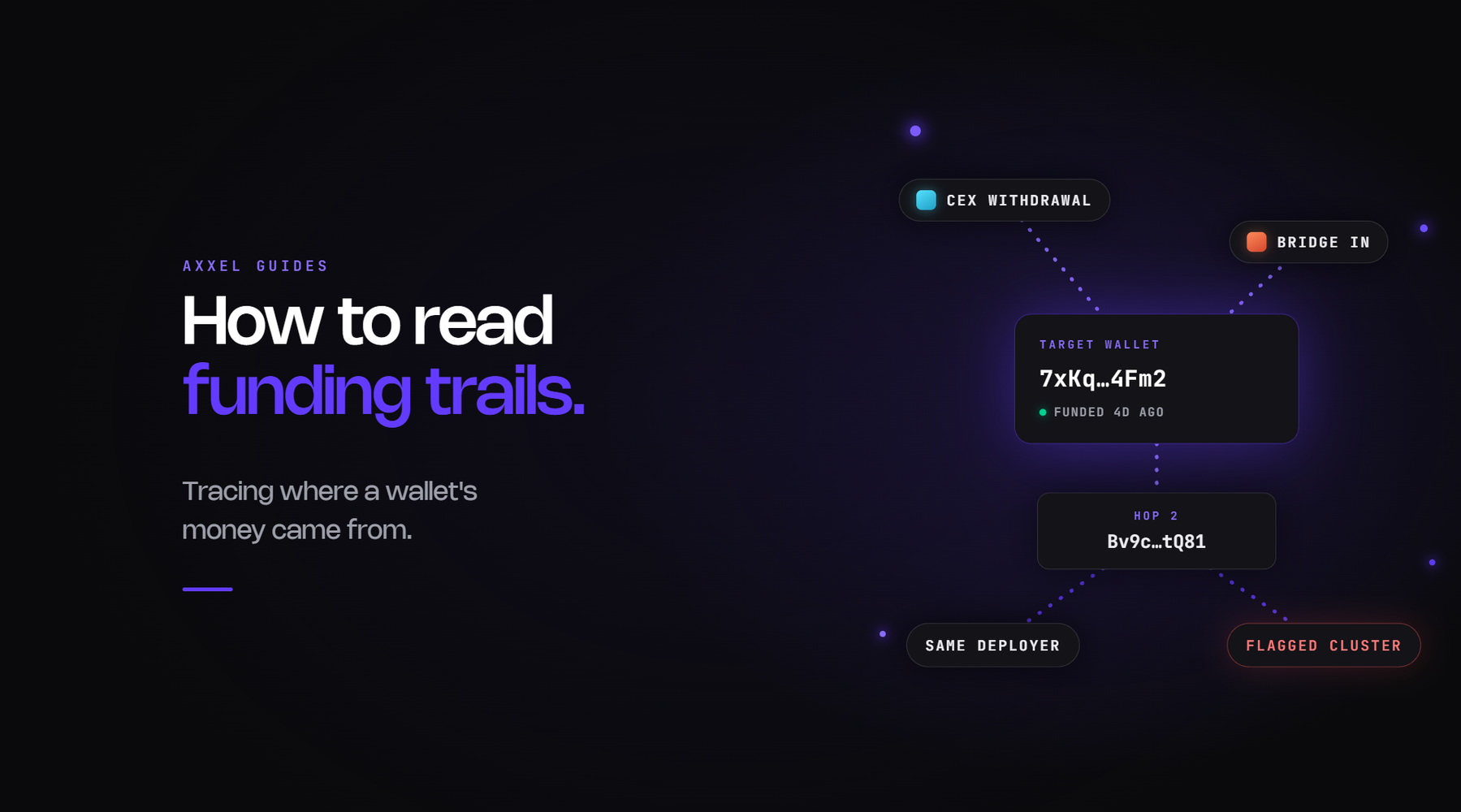
Every wallet's first transaction is money arriving from somewhere. That somewhere is another address, and that address has its own history.
Following the chain backwards tells you where a wallet's money originated, and more usefully, whether several wallets share an origin. It's public, it's free, and it takes about two minutes per token.
How to do it
Open a block explorer. Solscan, Etherscan, BscScan, Blockscout, whichever matches the chain.
Find the wallet's first inbound transaction. Sort its transaction history oldest first. The earliest entries show where its initial funding came from.
Note the sending address. This is the funder. Click into it.
Repeat for other holders. Take the top ten or fifteen holders and do the same for each.
Compare. If several trace back to the same funder, they're connected. If they trace back to different exchange withdrawal addresses at different times, they're probably genuinely separate people.
The patterns worth recognising
One funder, many wallets, short time window. The clearest signal. One entity spread supply across addresses to look distributed. Usually established at launch, which is what bundlingdescribes.
Chained funding.Wallet A funds B, B funds C, C funds D. Someone adding hops to obscure the connection. More effort than a single funder, same conclusion.
Common exchange, different times.Several wallets funded from the same exchange hot wallet months apart is meaningless. Exchange hot wallets fund millions of addresses. This is the false positive to watch for.
Fresh wallets, no history. Addresses created the same day the token launched, funded once, holding a large share. Not proof of anything on its own, but combined with a common funder it's decisive.
Old wallets with real history. The opposite signal. A holder that's been trading for two years across many tokens is much more likely to be a genuine participant.
What it exposes that a holder list doesn't
Fake distribution. The main one.
Sybil activity in rewards programmes.Someone farming an airdrop across fifty wallets funded from one source.
Whether a "community takeover" is real.If the new lead holders trace back to the original deployer, the takeover is the same people with a new story.
Connections between projects. A deployer's funding wallet often funded their previous deployers too, which is how you find that four apparently unrelated tokens share an operator.
The limits
Determined operators use exchange deposits, bridges, mixers or long hop chains to break the trail. If someone routes funds through a centralised exchange, the trail stops at the exchange's address and you can't follow it further without information you don't have.
So this catches the ordinary version, which is most of them, and misses the careful version. That's the same trade-off as every on-chain check.
It also takes time. Two minutes per token is fine for something you're about to size into; it's not a screening tool for forty candidates a day.
Tools that speed it up
Cluster visualisation tools like Bubblemaps render funding relationships as a graph, which is far faster than clicking through manually and is usually enough to spot the obvious cases.
Worth knowing that bundler software is now explicitly marketed as defeating those tools, generating wallet profiles that hold unrelated tokens so they don't read as fresh. Which means the visualiser is the first pass and the explorer is what settles it when something looks off. More on reading the explorer directly in how to use a block explorer.
Where it fits
This isn't part of the thirty-second check. It's what you do when a token has passed everything else and you're about to commit real size, or when a holder distribution looks suspiciously even.
The broader sequence is in the five-minute research routine. Funding trails are the step past it, for the ones that matter.
Axxel includes token analysis alongside market, limit, trailing and sniper orders, stop loss and take profit, MEV protection and configurable slippage and tax limits across Ethereum, Base, BSC, Solana and Robinhood Chain. Flat 0.9%, non-custodial, no subscription.
The holder list shows you who holds. The funding trail shows you who they are.
Crypto trading carries risk. Most memecoins lose value. Nothing here is financial advice. Axxel is not available in all regions.