How to Tell When a Memecoin Has Topped (Before the Chart Tells You)
Tops don’t announce themselves, but they leave the same five fingerprints almost every time. Here’s what to look at, in order, and what to do when three of them show up together

Merlin
Author
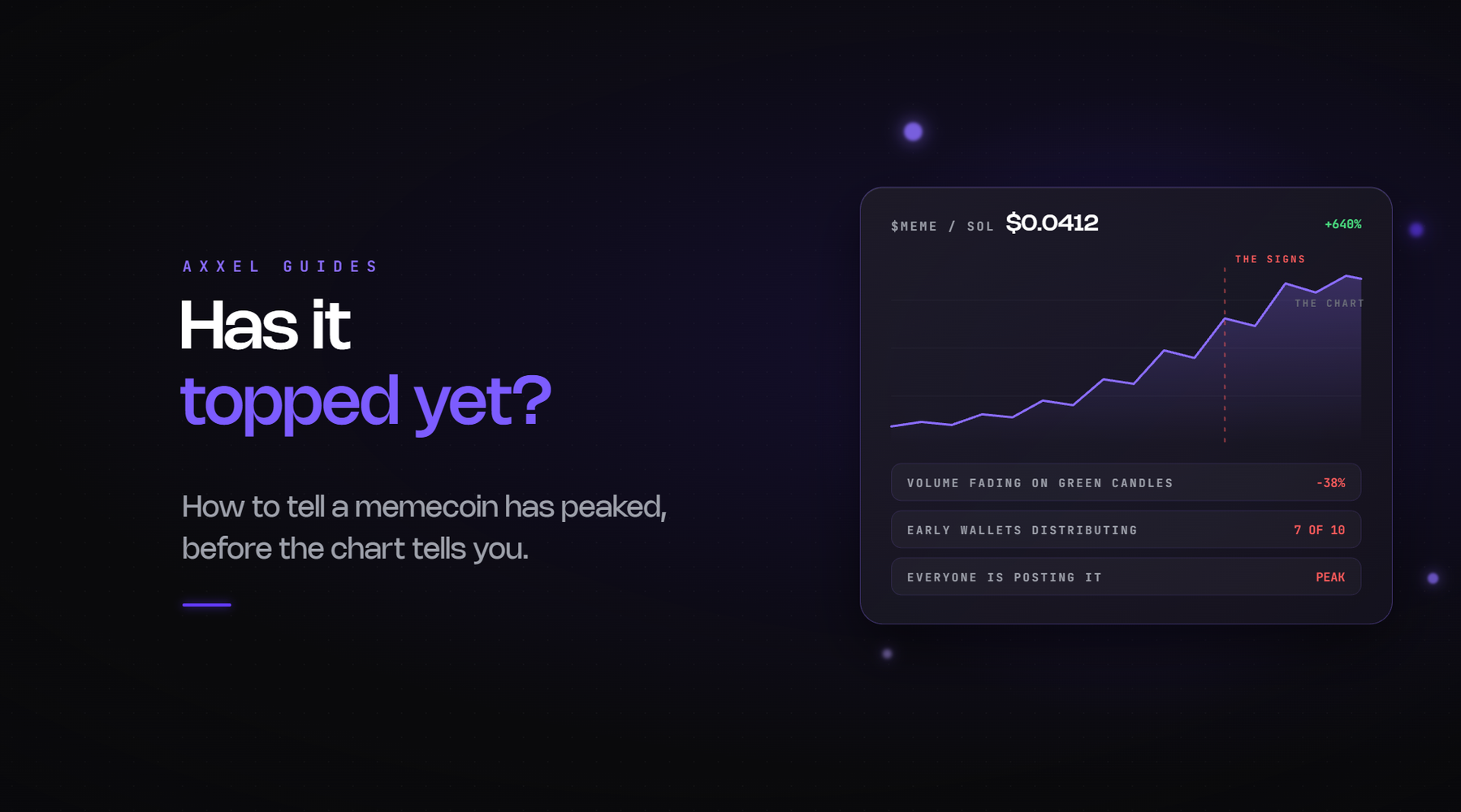
Nobody rings a bell at the top. But look back at any memecoin chart after the fact and the top is rarely a mystery. The same handful of things were happening, and they were visible at the time to anyone looking at something other than the price.
This is a companion to when to sell. That post is about your plan. This one is about the market’s tells.
Why tops are hard to see from inside
The last leg of a run is the part where you’re most convinced. You’ve been right for days, the group chat is loud, and every dip has been bought. That’s exactly the state in which the signals below get ignored, because they’re quiet and the price is loud. Buying the top and holding through it are the same mistake from different angles: trusting the price over the things that make the price.
The five fingerprints
1. Volume fades while price holds. The earliest and most reliable one. Price is flat or grinding up, but each push comes on less volume than the last. That means the buying that got it here is running out, and the price is being held up by the absence of sellers rather than the presence of buyers. Compare the volume on the last three pushes on the pair page. If they’re shrinking, the move is tiring.
2. Holder growth stalls. A healthy run adds new wallets every hour. A topping run adds almost none while price still climbs, which means the same people are bidding it up among themselves. Check the holder count on the pair page morning and evening. Flat holders with a rising price is distribution waiting to happen. Holder distribution over time tells you more than any single candle.
3. The big wallets start trimming. Not dumping. Trimming. A top-20 wallet sells 10% into strength, then another does, then the dev cluster starts splitting supply. None of it moves the price much on its own because there’s still demand to sell into. That’s the point: smart money exits while there’s a bid, which is before you notice. Tracking the whale wallets on a token you hold is the most useful ten minutes you’ll spend on it.
4. The KOLs arrive all at once. When four or five callers post the same token in the same afternoon, it’s rarely organic discovery. Someone is paying for distribution, and people pay for distribution when they need buyers. A cosign early in a run is attention. A pile of them late in a run is exit liquidity being recruited.
5. The catalyst lands. The listing, the partnership, the thing everyone was holding for. Listings in particular are bought in advance and sold on the day with remarkable consistency. If the whole thesis for holding was one event, the event is the exit for everyone who shared the thesis, and they’re all selling into the same hour.
Two that look like tops but aren’t
A fast 30% dip. On a memecoin that’s a Tuesday. If volume is still rising and holders are still growing, a sharp dip is a shakeout, not a top. The dead cat bounce post covers how to tell a dip from a reversal from the other direction.
The chart “looking extended.” Memecoins that have done 10x do 30x regularly. Price alone tells you nothing about the top. The signals above are about who’s buying and who’s selling, which is the only thing that does.
When three show up together
One signal is noise. Two is worth tightening your exit. Three in the same 24 hours is a top until proven otherwise.
The response isn’t to dump everything, because you’ll be wrong sometimes and the run will continue without you. It’s to take your original stake off the table if you haven’t already, move your trailing stop up to lock in most of what’s left, and stop adding. If it keeps running, you’re still in. If it doesn’t, you kept the trade.
The mistake almost everyone makes is treating “it’s topping” as a prediction they have to be certain about before acting. You don’t need to be certain. You need to be positioned so that either outcome is fine.
Why the last leg costs the most
Memecoins dump faster than they pump, and the gap between the top and the first serious bid below it is often 40% to 60%. So a position that’s up 300% and holds through the top is routinely back to up 50% within a day, with the holder convincing himself it’s a healthy retrace the whole way down. The last 20% of a run is where most people give back the first 200%, and it’s because the signals were there and the price was louder.
Axxel includes token analysis across Ethereum, Base, BSC, Solana and Robinhood Chain, alongside market, limit, trailing and sniper orders, stop loss and take profit, MEV protection and configurable slippage and tax limits. Flat 0.9%, non-custodial, no subscription.
The price is the last thing to know it’s over. Everything else finds out first.
Crypto trading carries risk. Most memecoins lose value. Nothing here is financial advice. Axxel is not available in all regions.