How to Find and Track Whale Wallets on Memecoins
A whale is relative to the pool, not the dollar amount. Here's how to find the ones that matter and what their moves actually tell you.

Merlin
Author
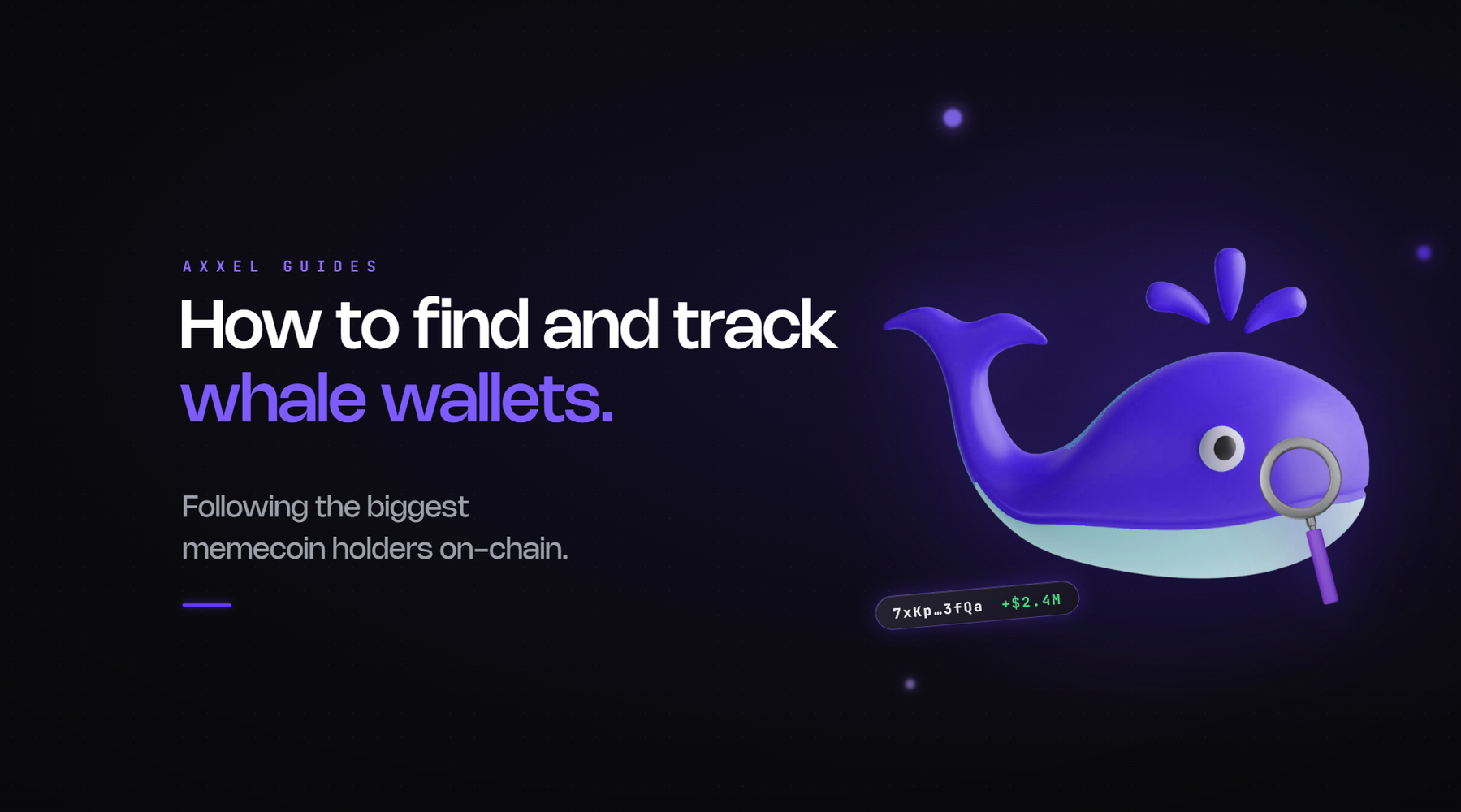
On a large-cap coin a whale is someone with tens of millions. On a memecoin with a $400k pool, a whale is anyone holding $30k, because that's enough to move the price on the way in and crater it on the way out.
That's the first thing to get right. Whale is relative to liquidity, not to a dollar figure, and it's the wallets large relative to the pool that decide what happens next.
Where to find them
The holder list. Any screener's token page shows the top holders by percentage. That's your starting set, and the top ten to twenty is usually enough.
The top traders tab. Wallets ranked by realised profit on this specific token. Different list from the holders, and often more useful, because it shows who's been actively moving rather than who's sitting.
The live transaction feed. Large buys as they happen. A $40k buy on a two-hour-old token is worth clicking on immediately.
The explorer. For anything you're taking seriously, the block explorer gives you the full history rather than the screener's summary.
Who to filter out first
Most of the top holder list isn't a whale in any useful sense.
Pool contracts and burn addresses. They'll often be the largest holders. Not people.
Exchange wallets. Big, and meaningless for your purposes.
Market-making and arbitrage bots. High transaction counts, thin margins, on the leaderboard by volume. How to spot them.
The deployer's cluster. If several top wallets trace back to the same funding source, they're one entity, and that entity is the bundle, not a set of independent whales.
What's left after that is usually a handful of wallets, and those are the ones worth watching.
What to actually watch
Direction, not size. A whale holding is neutral. A whale accumulating across several buys is one signal. A whale distributing, selling in tranches into strength, is the signal that matters most, because it's usually what the top looks like from the inside.
Age and history. A wallet that's been trading for two years across many tokens is a person with a track record. A wallet created the day the token launched is something else. Fresh wallets have their own read.
Whether they're connected. Two whales funded from the same address are one whale who wants to look like two. The funding trail settles it.
What else they hold. Click through. A wallet that's early on things that ran is worth more attention than one that's early on things that died.
Tracking them
Once you've got a shortlist, most screeners and tracking tools let you save an address and get alerts on its activity. The wallet's balance changes tab on the explorer is the ground truth when a tracker's summary looks off.
Keep the list short. Five wallets you actually understand beats fifty you're vaguely aware of.
The trap
Everyone who starts tracking whales has the same idea: buy what they buy. It mostly doesn't work, for three reasons.
By the time a whale's buy is visible, the price has moved. You're getting their entry at a worse price with none of their exit.
Known whale wallets are watched by bots. Your copy of their move is behind the bots' copy of their move, and the bots are faster.
And whales are sometimes the dev in a different wallet. Following them in is following the seller.
The useful version of whale tracking is the reverse. A whale selling is a stronger signal than a whale buying, because it's information about the top rather than the bottom, and the top is where you lose money. The smart money and KOL wallet pieces cover the same trap from different angles.
Where it sits
Whale reading is one input in the research routine, and it's more useful while you're holding than before you buy. Concentration tells you the risk at entry. Whale behaviour tells you when the risk is being realised.
Axxel includes token analysis alongside market, limit, trailing and sniper orders, stop loss and take profit, MEV protection and configurable slippage across Ethereum, Base, BSC, Solana and Robinhood Chain. Flat 0.9%, non-custodial, no subscription.
Find the wallets big enough to move the pool. Then watch which way they're moving it.
Crypto trading carries risk. Most memecoins lose value. Nothing here is financial advice. Axxel is not available in all regions.