How to Tell If a Wallet Is a Bot
Half the "top traders" on any leaderboard aren't people. Here's how to spot them in thirty seconds.

Merlin
Author
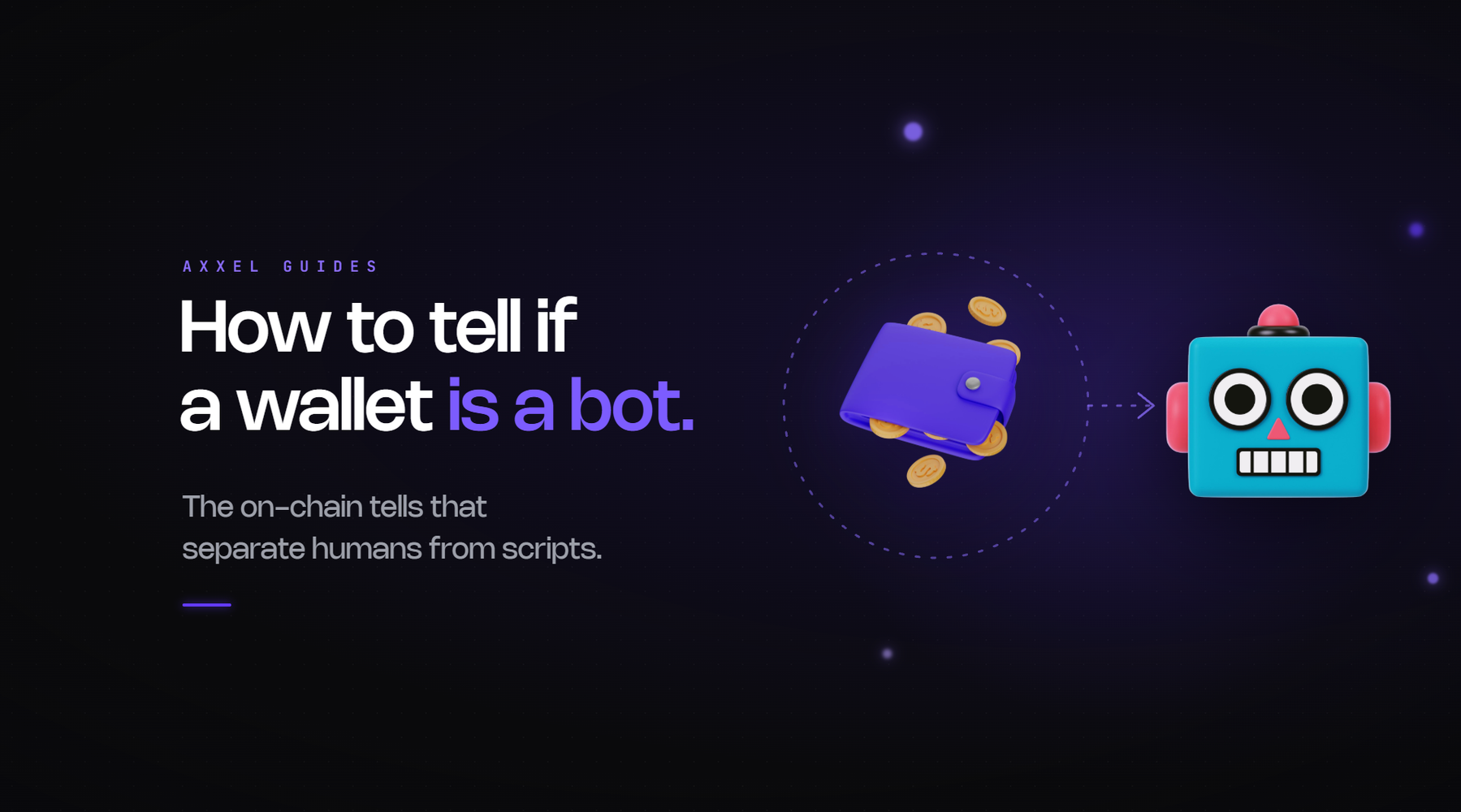
Open any token's top traders list and a good share of what you're looking at isn't a person. It's a script, and it's been running since the pool was created.
That matters for three reasons. You can't copy a bot's strategy by watching its trades. Its volume tells you nothing about human interest. And if it's at the top of a leaderboard you were using to find good traders, you've found the wrong thing.
The five signals
1. Transaction count against time. A wallet with 20,000 transactions on a token that's a month old is trading hundreds of times a day. No human does that. On the CATE leaderboard a few weeks ago, the sixth-ranked wallet had exactly this profile: nearly $10 million in and nearly $10 million out across 20,000 trades, for a 4.67% realised margin. That's a market maker working a spread, not a trader.
2. Regularity. Pull up the transaction history. Human trading is lumpy: bursts, gaps, odd sizes, nothing for six hours then five trades in a minute. A bot trades at intervals and in sizes that look like they came from a config file, because they did.
3. Thin, consistent margins. Arbitrage and market-making bots make small percentages on large volume. A wallet that's up 3 to 5% on everything it touches, never more, never less, isn't picking winners. It's extracting spread.
4. Never a loser. Humans have bad trades. A wallet with hundreds of round-trips and no losing positions is either the luckiest person alive or a bot that only executes when the arithmetic is already in its favour.
5. No social footprint. Not decisive on its own, since plenty of real traders are anonymous, but a wallet doing enormous volume with no label, no linked account, and a funding source that's a bridge or a contract rather than an exchange, leans mechanical.
The types you'll meet
Market makers provide liquidity and earn the spread. High transaction counts, tiny margins, on the leaderboard by sheer volume. Harmless, and useless to copy.
Arbitrage bots exploit price differences between pools. Same profile, and they tend to appear on tokens that trade in multiple venues.
Sniper bots buy in the first block of a launch and sell within minutes. Few transactions per token, many tokens, consistent small profits. These are the ones that make being early a race.
Wash bots trade with themselves to manufacture volume. Round-trips of similar size at regular intervals between a small set of wallets. Covered in what is wash trading.
Copy bots mirror a target wallet. They show up as buys landing a few seconds after a known wallet's, at slightly worse prices, every time.
Why it matters
Leaderboards mislead. If you're using a token's top traders to find smart money, the bots at the top aren't it. Filter them out before you draw conclusions about who's good.
Volume misleads. A token with heavy volume and three bot wallets accounting for most of it has less human interest than the number suggests. This is the makers-against-transactions check in practice.
Copying doesn't work. A bot's edge is speed and infrastructure. Watching what it bought and buying the same thing gets you its entries at worse prices with none of its exits.
What to do when you find one
Nothing, mostly. Note it and move on. The useful outcome is that the remaining wallets on the list are the ones worth looking at, and they're usually further down than you'd expect.
If you're doing wallet research seriously, tools like GMGN label some bot activity automatically. For anything unlabelled, the five checks above take about thirty seconds on a block explorer, and the transaction count alone settles most cases.
Axxel includes token analysis alongside market, limit, trailing and sniper orders, stop loss and take profit, MEV protection and configurable slippage across Ethereum, Base, BSC, Solana and Robinhood Chain. Flat 0.9%, non-custodial, no subscription.
The leaderboard tells you who made money. It doesn't tell you who was there.
Crypto trading carries risk. Most memecoins lose value. Nothing here is financial advice. Axxel is not available in all regions.