What Is Exit Liquidity? How to Tell If You're About to Be It
Every sell needs a buyer. Here's how you end up being the buyer, and the five checks that tell you in advance.

Merlin
Author
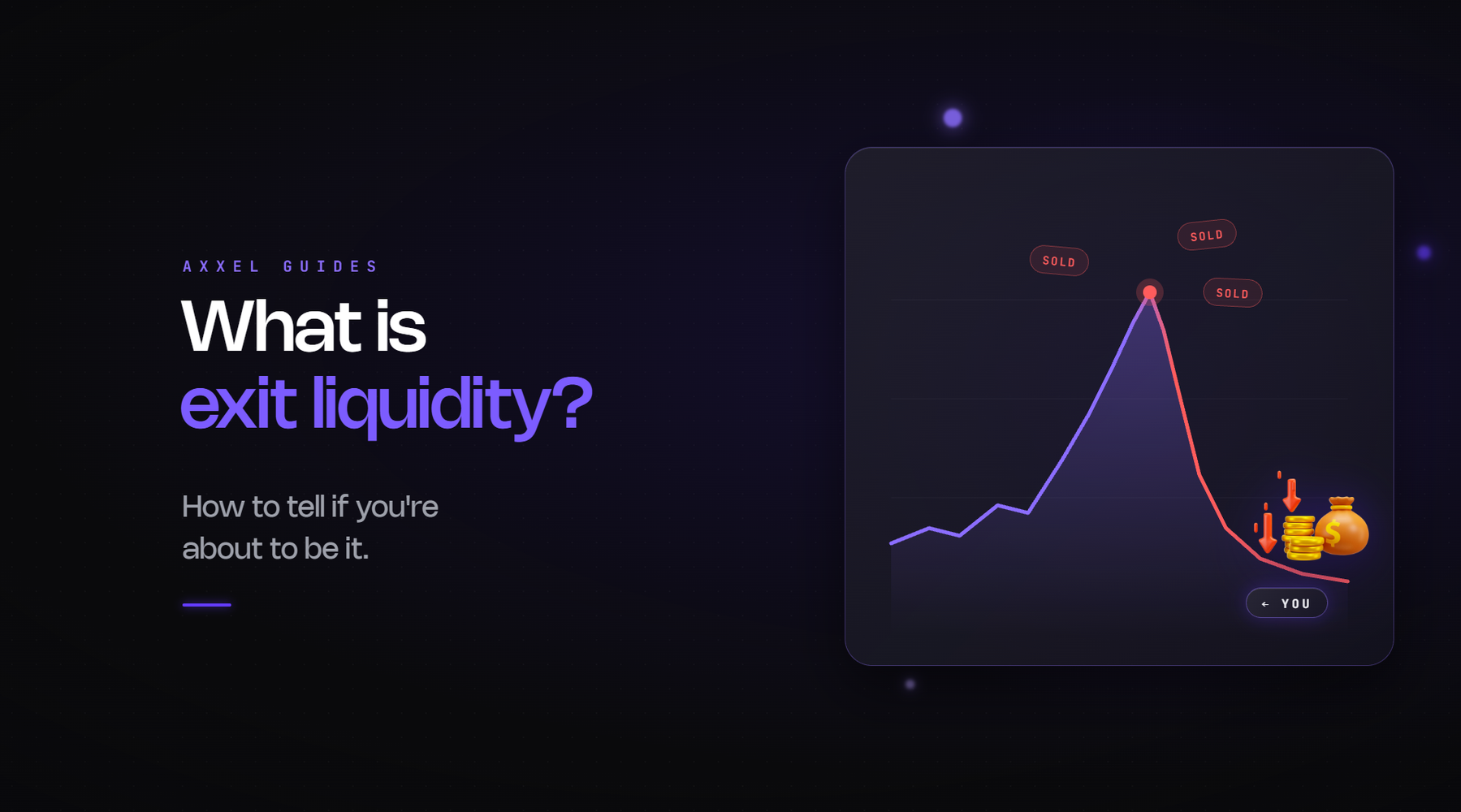
Every sell needs a buyer. When someone who bought a token at $2m sells it at $40m, the money they take out came from whoever bought at $40m. That buyer is the exit liquidity.
It's not an insult, though it's used as one. It's a position on the timeline. Everyone is exit liquidity for someone who was earlier; the question is whether you're also someone's entry, or whether you're the last one in.
The seven ways people become it
Buying a cosign after the poster bought. A big account posts a token. By the time you see it, they've bought, their circle has bought, and the bots watching their wallet have bought. Your buy is what those three groups sell into. The on-chain checks are in how to read a KOL cosign.
Buying after the move. A token is up 400% in an hour and you buy because it's up 400%. The people who made the 400% now need someone to sell to. Chasing is the most reliable way to be the exit, and it's covered from the psychology side in why do I keep losing money.
Buying into manufactured volume. Wash trading exists to attract real buyers. Once you're in, the wallets that made the volume sell to you.
Buying a bundled launch. The deployer holds 40% of supply across a dozen wallets from block one. Every buyer after that is a potential exit for those wallets. What is a bundled token covers how to spot it.
Buying from a trending list. Trending placement is often paid for. Someone paid to put the token in front of you because they need buyers, and you're the buyer.
Buying a "community takeover" run by the dev. The dev "leaves," the community "takes over," and the buyers who come in on the new story are selling to the same wallets as before. How to verify a CTO.
Buying listing news. A token gets listed somewhere and runs. The people who were positioned before the announcement sell into the people who heard about it from the announcement.
How to tell in real time
Five checks, about a minute total.
Who's selling into this move? Look at the top holders' recent transactions. If the largest wallets are distributing while the price rises, that's who you'd be buying from.
Did the volume come with holders? Rising volume and flat holder count means the same wallets churning, which means the buyers are being manufactured and you'd be a real one.
How far had it run before you saw it? If the answer is "a lot," the people who made that money are looking for you.
Is the person telling you about it holding or leaving? Check their wallet. Posting and selling at the same time is the tell.
Where's the supply? If it's concentrated in wallets that bought before the run, those wallets are the sellers and you're the market.
The full sequence is in the five-minute research routine.
How not to be it
Three ways, and most people who last use all three.
Be earlier. Not to the token you've heard of, to the chain or meta before it's on trending. The mechanics are in how to find new memecoins early and what is a meta.
Be the one exiting. Set the sell at entry and scale out on the way up. Then when the late buyers arrive, you're the one they're providing liquidity for. When to sell a memecoin.
Size so it doesn't matter. You'll be exit liquidity sometimes regardless. Position sizing means the times it happens are annoying rather than ruinous.
The honest bit
Even good traders are someone's exit. The difference is they're also the one exiting, more often than not, and the trades where they were the buyer at the top were small enough to shrug at.
The goal isn't to never be exit liquidity. It's to know when you're about to be, and to decide whether the size is worth it.
Axxel includes token analysis alongside market, limit, trailing and sniper orders, stop loss and take profit, MEV protection and configurable slippage across Ethereum, Base, BSC, Solana and Robinhood Chain. Flat 0.9%, non-custodial, no subscription.
Every sell needs a buyer. Try not to be the one who arrived last.
Crypto trading carries risk. Most memecoins lose value. Nothing here is financial advice. Axxel is not available in all regions.