How to Tell a Dev Is About to Sell (Before the Candle)
The dump is the last step, not the first. Here are the on-chain and off-chain moves that usually come before it, and what to do when you spot two at once

Merlin
Author
“Dev sold” is the candle everyone screenshots. It’s also the last step. By the time the sell lands, the setup has usually been running for hours or days, and most of it was visible to anyone looking at the right wallet.
This isn’t about predicting every dump. Some devs just hit sell with no warning. But the ones who are organised about it leave a pattern, and the pattern has maybe eight common moves. What happens after the sell is covered separately. This is the before.
First, know which wallet you’re watching
None of this works if you’re watching the wrong address. Find the deployer wallet, then trace what it funded, because the dev’s real holdings are often not in the deployer at all but in five wallets the deployer paid gas to on launch day. The bubble map shows that cluster faster than reading transactions. Once you’ve got the cluster, the signals below are about what it does next.
The on-chain signals
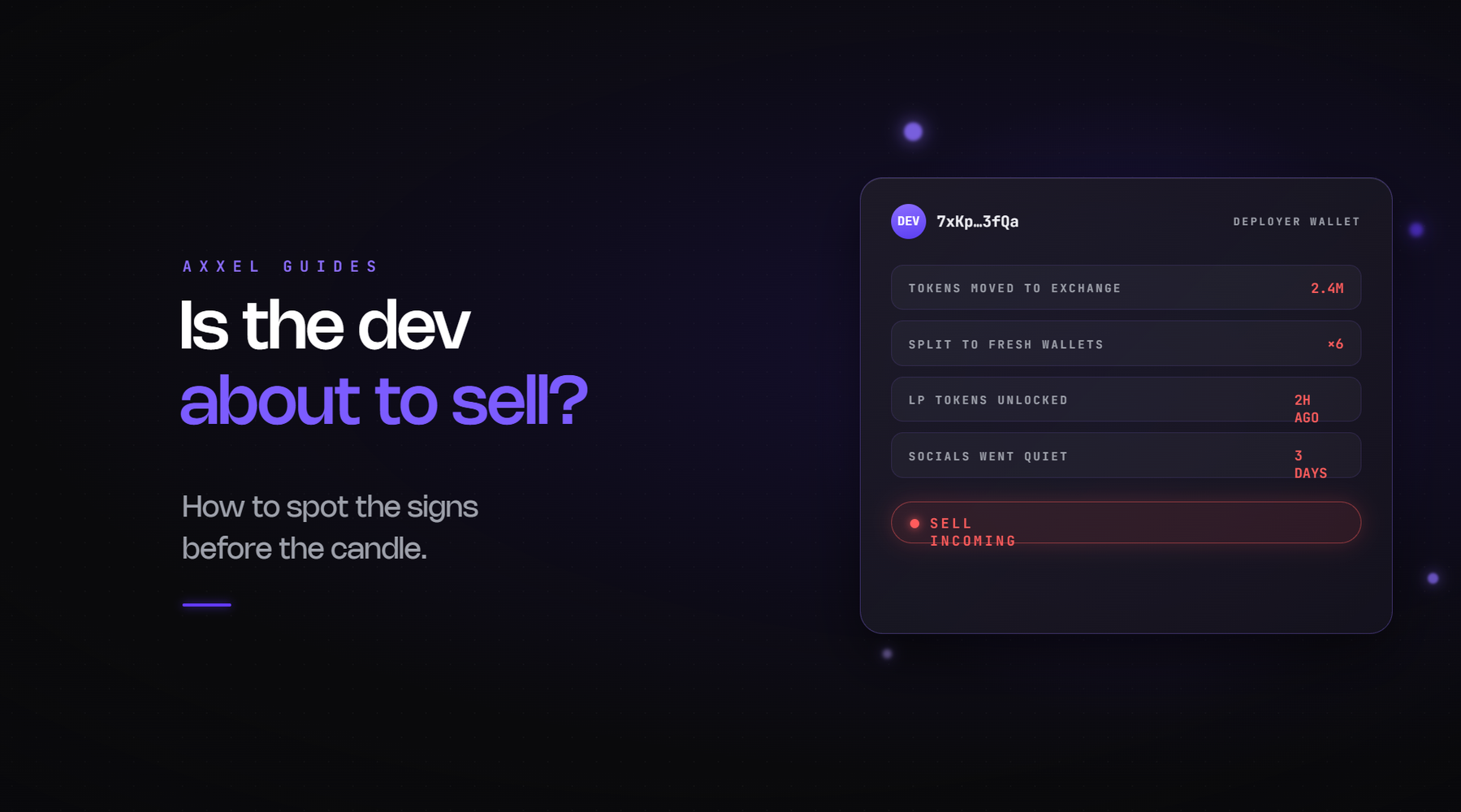
Supply gets split. One wallet holding 15% becomes eight wallets holding 2% each. Nothing has been sold yet. The purpose is that eight small sells don’t trigger the alerts one big sell would, and the holder list looks healthier on DexScreener while it happens. A dev wallet suddenly busy with outbound transfers to fresh wallets is the single most reliable early sign.
Tokens move toward an exchange. A transfer to a known exchange deposit address is a sell with a delay on it. Explorers label the big ones. If the dev cluster is sending to one, the sell is already in motion.
The dev buys with a fresh wallet. A new wallet, funded by the deployer, buying the token loudly while the main dev wallet sits still. It reads as conviction. It’s usually a prop for the next stage, either to show “dev is buying” screenshots or to seed a wallet that can be sold from without the dev tag.
Something changes in the contract. A tax edit, a max-wallet change, a lock extended by a tiny amount so it looks like a lock. Any contract write from the owner in the days before an unlock date is worth reading in full.
An unlock is coming. If liquidity or team tokens are locked rather than burned, there’s a date. Price action in the week before it is rarely a coincidence. Burned versus locked is the first thing to check on any token you plan to hold more than a day.
The off-chain signals
A KOL blitz out of nowhere. Three or four callers posting the same token in the same hour, with the same talking points, is usually paid, and paid promotion right before a sell has a specific purpose: it’s recruiting the buyers. Reading a cosign properly matters most exactly when the chart looks best.
A migration or “v2” announcement. New contract, upgraded token, “swap your old tokens here.” Sometimes legitimate. Often a way to reset the holder base and the dev’s wallet tags at the same time, and the old token tends to get sold into during the confusion.
Socials go quiet, or get handed over. Posting slows, the dev stops replying, then a “community takeover” is announced. A real CTO has a specific shape, and the dev-driven version is a sell with a cover story.
Vague catalyst teasing. “Big partnership next week”, “listing confirmed, can’t say where”. A real catalyst has details. A tease with none is usually there to hold the price up while someone leaves.
When the signals stack
One signal is noise. A dev splitting supply might be setting up a marketing wallet. A KOL blitz might just be a KOL blitz.
Two signals in the same 24 hours is a pattern, and three is a plan. The practical response isn’t to panic sell on a transfer. It’s to take your stake off the table, tighten the trailing stop on what’s left, and stop adding until the cluster has shown you what it’s doing. If the dev cluster sends to an exchange or a sell lands from a wallet in the cluster, you’re already out of the part that mattered.
The reverse is also true. A dev cluster that hasn’t moved in a month while holders grow is one of the quieter bullish signals there is, and almost nobody checks it.
The slow version
Not every dev dumps in one candle. Plenty bleed out a fraction of a percent of supply every day for weeks, below the level that trips any alert. That’s a chart that goes nowhere while the holder count rises, and it’s why the holder distribution over time tells you more than any single transaction. If the dev cluster’s share is falling steadily and the price isn’t rising, you’re the one buying it.
Axxel includes token analysis across Ethereum, Base, BSC, Solana and Robinhood Chain, alongside market, limit, trailing and sniper orders, stop loss and take profit, MEV protection and configurable slippage and tax limits. Flat 0.9%, non-custodial, no subscription.
The candle is the end of the story. The wallet tells you the beginning.
Crypto trading carries risk. Most memecoins lose value. Nothing here is financial advice. Axxel is not available in all regions.