Does Burning Tokens Increase the Price? (And What “LP Burned” Actually Means)
Supply burns and liquidity burns are two different things that get announced in the same tone. Here’s what each one actually changes, which ones are signal, and how to verify a burn in thirty seconds

Merlin
Author
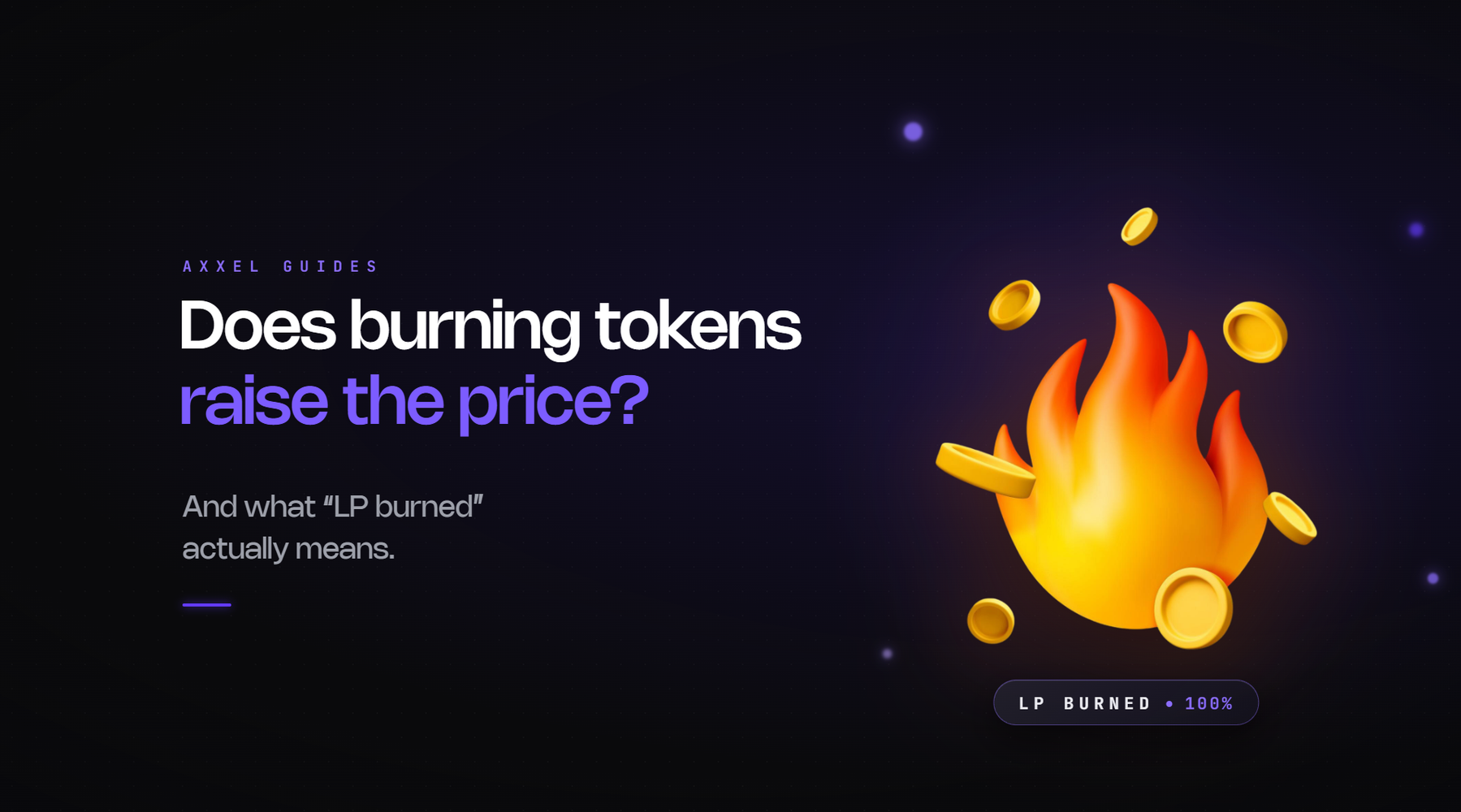
One word does a lot of work in memecoin marketing: burned. Sometimes it’s “we burned 40% of supply.” Sometimes it’s “LP burned.” Both get posted with fire emojis and both get read the same way, as “safe, going up.” They’re different things, and only one of them is about safety.
What a burn is
Sending tokens somewhere nobody can get them back from. On Ethereum, Base and BSC, that’s usually the dead address (0x000…dEaD) or the zero address. No private key exists for either, so whatever goes in never comes out. On Solana, tokens are burned through the Token Program itself, which destroys them rather than parking them. Either way the tokens stop existing in any practical sense, and the explorer will show it.
Supply burns, and the maths
Say a token has 1 billion supply at $0.001, so a $1M market cap. The team burns 500 million. There are now 500 million tokens and the same $1M of demand, so each token is worth $0.002. The price doubled. Your holding is worth exactly what it was a minute ago, because the market cap didn’t move. Nothing about how many people want the token changed.
So why does price sometimes rise after a burn? Because the announcement is a catalyst and people buy the news. That’s demand created by marketing, not by the burn, and it fades the way most announcements fade.
There’s one case where a supply burn is real. When the burned tokens were an overhang. A dev who burns their own 20% allocation has removed 20% of supply that could have been dumped on you. That’s a change to your risk, not to the maths. A dev who burns tokens nobody was ever going to sell, an unclaimed presale allocation or a “community reserve” no one could access, has changed nothing. The rule: a burn matters in proportion to how likely those tokens were to be sold. Dev sold is the thing a burn can prevent, and it’s the only thing.
Buyback and burn is a different animal
Buying tokens from the open market with fees or revenue, then burning them, is not the same as burning tokens you already held. The buying is real demand hitting the pool. The burn just makes it permanent. Fee-router tokens are built on this, and it can work. The check is whether the buybacks are actually happening on-chain at the claimed cadence, or whether they happened once for the screenshot.
Burn taxes, where a percentage of every trade is burned, are the slow version: a tiny continuous supply reduction that’s mostly cosmetic, and a tax you pay on every trade either way.
LP burned: the one that’s about safety
When someone creates a liquidity pool, they receive LP tokens representing their share of it. Whoever holds those LP tokens can withdraw the liquidity. That withdrawal is the classic rug pull: the pool empties in one transaction and there’s nothing left to sell into.
Burning the LP tokens sends them to the dead address, so nobody can ever withdraw. The pool is permanent. On pump.fun, graduated tokens have their LP burned automatically, which is why that specific rug is off the table there.
Burned is not the same as locked. Locked LP sits in a locker contract for a set period, three months, a year, after which the dev gets it back. Burned is forever. A lock with an expiry a few weeks out is a countdown, and the date is public.
What LP burned doesn’t do
This is where people get hurt. A burned pool means the liquidity can’t be pulled. It says nothing about the supply.
The dev can still hold 30% of the tokens and sell them into that permanent pool, which is how most memecoins actually die now. Mint authority, if it’s still live, can still create more tokens. Freeze authority can still freeze yours. A mutable tax can still change. Whatever was bundled at launch is still sitting in wallets waiting. LP burned makes exactly one exit impossible and leaves every other one open.
How to verify a burn in thirty seconds
A supply burn: open the token on the explorer and look at the holder list. The dead address should be near the top with the claimed percentage. On Solana, compare current supply with launch supply; pump.fun tokens start at 1 billion, so the maths is easy. A burn with no transaction link attached is a tweet.
An LP burn: find the pair’s LP token (the pair page on DexScreener shows the pool contract) and check who holds the LP tokens. Dead address means burned. A locker contract means locked, so read the unlock date. The dev’s own wallet means neither, whatever the announcement said.
The pool trick: a token can have several pools. “LP burned” on a tiny secondary pool while the real one sits unlocked is a thing that happens. Check you’re reading the pair that carries the volume, not the one in the screenshot.
How to think about it
A supply burn is a marketing event that occasionally comes with real risk reduction, and the burned tokens tell you which. An LP burn is necessary and nowhere near sufficient. Neither is a reason to buy. Both are things to verify before you do.
Axxel includes token analysis across Ethereum, Base, BSC, Solana and Robinhood Chain, alongside market, limit, trailing and sniper orders, stop loss and take profit, MEV protection and configurable slippage and tax limits. Flat 0.9%, non-custodial, no subscription.
Fire emojis aren’t on the explorer. Check the dead address instead.
Crypto trading carries risk. Most memecoins lose value. Nothing here is financial advice. Axxel is not available in all regions.