What Are Fee Router Tokens? The Revenue-Sharing Meta Explained
Launchpads, lockers and protocols paying holders from real trading fees. How it works and what to check.

Merlin
Author
Most tokens have no cash flow. A growing category does, and it's worth understanding the difference because it changes what you're actually holding.
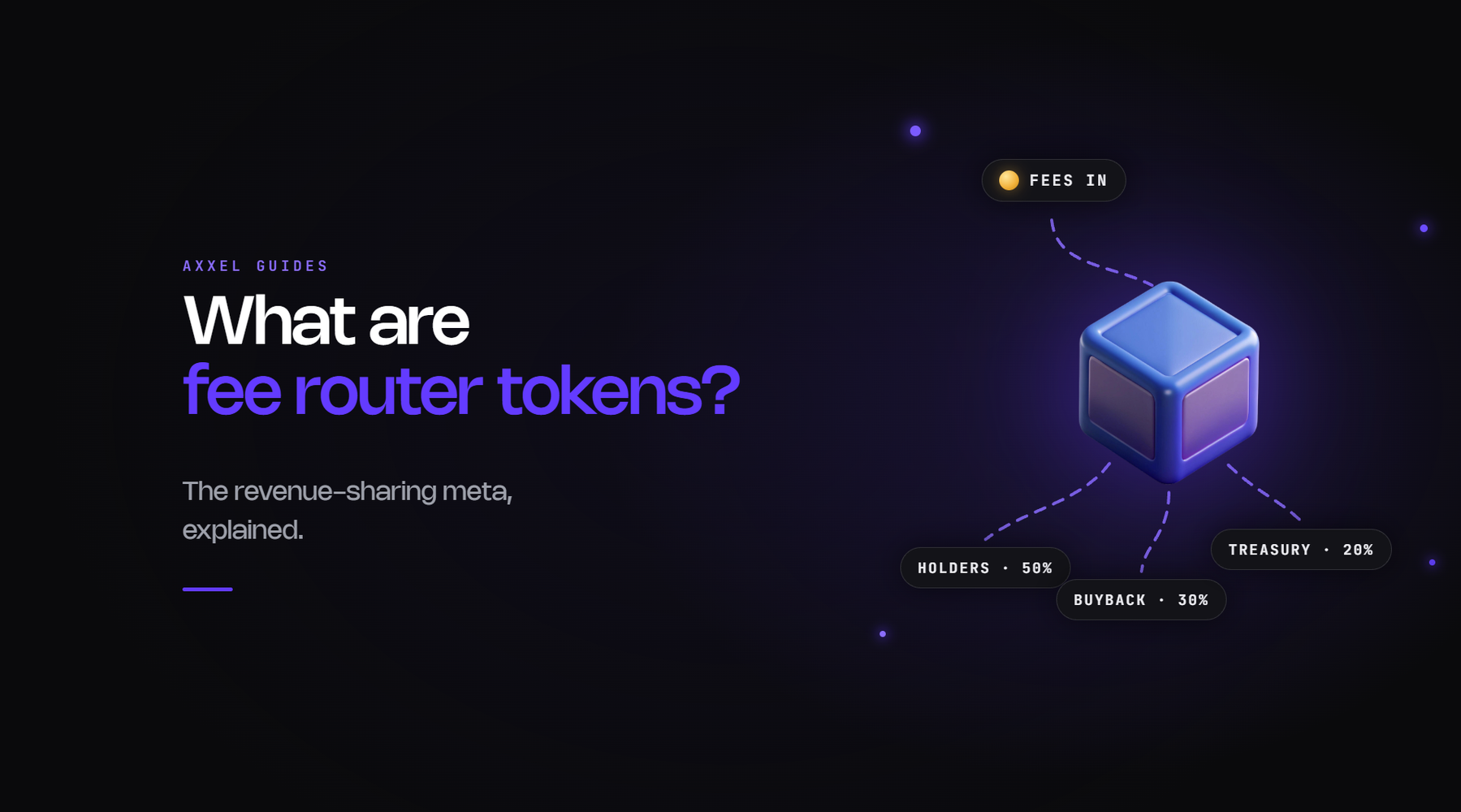
A fee router token is one where a protocol that earns money from real activity routes a share of that revenue to holders. Not a promise of future utility, not points, but a mechanism that pays out from fees other people are paying today.
Where the revenue comes from
Any protocol that takes a cut of activity can do this. In practice you'll see it in a few places.
Launchpads take a fee on every trade during a token's bonding curve and often a smaller cut afterwards. At scale that's substantial. Noxa reportedly generated around $12 million in fees before it shut down, which gives a sense of what a dominant pad on an active chain earns.
Liquidity lockers charge either an upfront percentage of locked liquidity or a share of the swap fees a locked position collects.
DEXs and aggregators take a fee on routed volume.
Trading tools take a fee per trade. Banana Gun is the established example, distributing 40% of platform fees to BANANA holders on a four-hourly cycle.
In each case the token's value has an actual input beyond attention, which is a structurally different asset from a memecoin.
How the distribution works
Three common patterns, and the difference matters.
Direct distribution. Fees accumulate in a contract and get paid to holders on a schedule or on demand. Simplest, easiest to verify, and the one where you can check whether it's actually paying by watching the contract.
Buyback. Fees are used to buy the token on the open market, which supports the price rather than paying you directly. Value accrues through price rather than through cash in your wallet. Harder to distinguish from normal buying pressure, and harder to verify.
Gated distribution. You have to do something to be eligible. Stake, hold an NFT, activate a position, or claim within a window. Stonk Brokers on Robinhood Chain runs a version of this where only activated broker NFTs receive drops, weighted by tier, and holders elect which tokens they want to receive.
The gated versions concentrate rewards on committed holders, which is the intent. It also means a portion of the revenue never reaches passive holders, which is worth knowing before you buy one expecting a yield.
The questions that matter
Five, and most tokens claiming revenue share fail at least one.
Is there actually revenue? A fee switch that exists but is set to zero produces nothing. Plenty of protocols have the mechanism built and haven't turned it on. Check what's currently being collected, not what could be.
Is it on-chain and verifiable? You should be able to look at the contract and see fees arriving and distributions going out. If the mechanism is described in a blog post rather than visible on-chain, treat it as a plan.
What proportion? "A share of fees" is not a number. 40% of fees on a protocol doing real volume is meaningful. An unspecified share of a protocol doing nothing is not.
Do you have to claim? Unclaimed distributions sometimes expire or get recycled. If the model requires action and you're not paying attention, you're funding the people who are.
Is the revenue durable? This is the big one. Launchpad fees depend on being the dominant pad, and pads churn fast. A token earning from a launchpad that loses its position stops earning. The Robinhood Chain ecosystem has already seen the leading pad change hands once.
Why this isn't equity
Worth being blunt. A revenue share from a protocol is not ownership, not a dividend, and not a legal claim on anything. Most of these projects state so explicitly in their own terms. Stonk Brokers' legal page, for instance, says its distributions are promotional rewards rather than dividends and confer no equity or shareholder rights.
That's not a criticism of them, it's an accurate description of what these are. A mechanism can pay you reliably and still be discretionary. If the team changes it, there's generally nothing you can do.
How to value one, roughly
If a protocol's fee revenue is public, you can do the arithmetic. Annualised fees, multiplied by the share routed to holders, divided by the token's market cap, gives you a rough yield.
That number is only as good as its inputs. Fee revenue in crypto is volatile, launchpad dominance is fragile, and a yield calculated from one exceptional month is meaningless. But it's a real calculation, which is more than you can do with most tokens.
Where it sits in the market
Fee router tokens have become a meta of their own, particularly on newer chains where the infrastructure is being built and the protocols capturing the flow are still small enough to be early to.
The trade is different from a memecoin trade. You're assessing whether a protocol will keep capturing revenue, rather than whether a narrative will keep capturing attention. That's a longer-horizon question with fewer catalysts, and the position sizing logic changes accordingly, though the base rate on small protocols is still unkind.
The checks in the research routine still apply. A token with a revenue mechanism can still have a mutable contract, a concentrated supply, or a deployer with a history.
Axxel supports Ethereum, Base, BSC, Solana and Robinhood Chain, with market, limit, trailing and sniper orders, stop loss and take profit, MEV protection and configurable slippage. Flat 0.9%, non-custodial, no subscription.
Revenue is the rarest thing in this market. When a token has some, check it's real before you price it in.
Crypto trading carries risk. Most tokens lose value. Nothing here is financial advice. Axxel is not available in all regions. Protocol details accurate as of publication; verify current terms directly.