Why Tokens With the Same Name Exist on Every Chain
Ticker collisions, deliberate copies, and how to tell which one is the one.

Merlin
Author
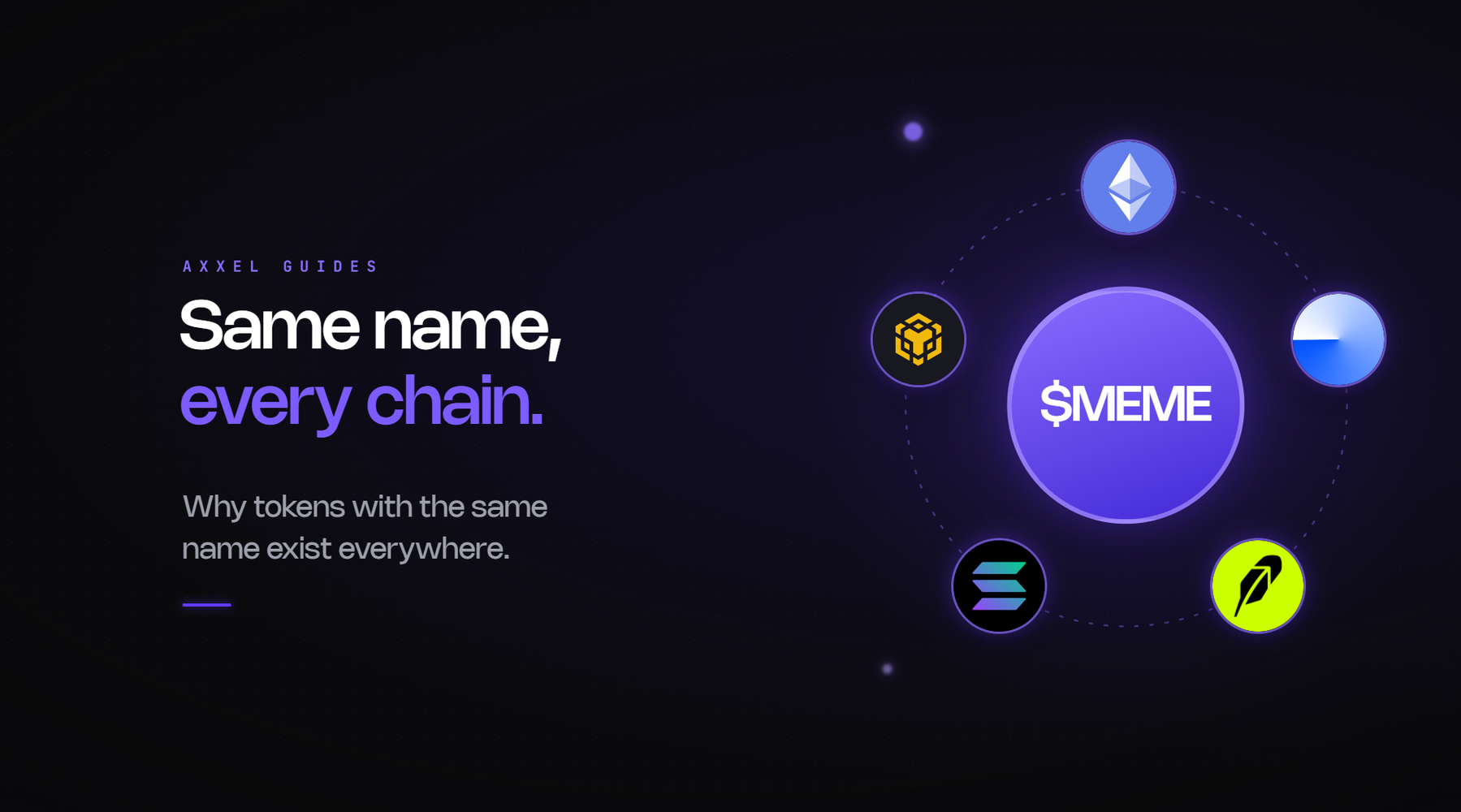
Search a trending ticker on any screener and you won't get one result. You'll get eight, across four chains, with different contracts, different market caps, and identical names and logos.
This catches more people than any other single mistake in memecoin trading, and it's entirely avoidable once you understand why it happens.
Why duplicates exist
Three reasons, and only one of them is malicious.
Nobody owns a ticker. There's no registry, no reservation, no uniqueness check. Anyone can deploy a token called anything, on any chain, at any time. Two people picking the same name independently is common, because the pool of good memecoin names is small and the number of launches is enormous.
Bridged and multi-chain versions. A token that exists on Solana may have a legitimate bridged version on another chain. Same project, different contract, both real.
Deliberate copies. Something runs on one chain, and within minutes there are versions of it on four others, deployed by people who had nothing to do with the original. Some are opportunistic and honest about it. Many exist specifically to catch people who search rather than paste.
That last category is the problem. It's cheap to deploy, the logo is a right-click away, and the entire cost of acquiring a buyer is being higher in a search result than the real one.
Why search is the trap
When you search a ticker on a screener, results are ordered by whatever that screener ranks on, usually liquidity or volume. A well-funded fake can outrank the original, particularly in the first hours of a run when the real token's pool is still small.
And the fake looks identical. Same name, same symbol, same image, sometimes a copied description. There is nothing visually distinguishing them.
The only thing that identifies a token
The contract address. Not the name, not the ticker, not the logo, not the chain.
Which means the rule is simple and absolute: get the contract address from the project's own source and paste it. Their site, their pinned post, their verified account. Never from a search result, never from a reply, never from a DM.
Then verify the paste resolved to what you expected. If you paste a contract into a screener and it shows a token with twelve holders created an hour ago, that's not the token that's trending.
How to tell which one is real
If you've got several candidates and need to work out which is which.
Age. The original is usually older. A version created after the run started is almost certainly a copy.
Holder count. The real one has the community. A copy has whoever got caught.
Liquidity and volume together. A fake can have volume from people buying by mistake, but it rarely has the holder base to match.
The project's own channels. Ultimately this settles it. If their site and their account say one address, that's the address, and everything else is someone else's token.
Check what's on the explorer. Paste each candidate into a block explorer and look at the creation date and the transaction history. The difference between a token with months of activity and one deployed this morning is immediately obvious.
The Robinhood Chain example
Worth knowing because it's an extreme case of the general problem.
Voxelithic, an aggregator on that chain, reported finding 39 contracts answering to a stock symbol that wasn't theirs, with the deepest of them holding over half a million in liquidity while trading almost nothing. Those aren't memecoin copies, they're duplicates of tokenised stock tickers, sitting in the ecosystem waiting for something to resolve a symbol to the wrong address.
If duplicates exist at that scale for tickers with real financial backing, assume they exist for every memecoin that's ever trended.
What actually protects you
Paste, never search. This one rule prevents the overwhelming majority of these losses.
Verify after pasting. Two seconds looking at the holder count and age.
Bookmark the contract if it's something you'll buy more than once.
Treat a name match as meaning nothing. Same discipline as the rug pull checklist, and it's the first item in the five-minute research routine for a reason.
Axxel trades by contract address across Ethereum, Base, BSC, Solana and Robinhood Chain, with token analysis, market, limit, trailing and sniper orders, stop loss and take profit, MEV protection and configurable slippage and tax limits. Flat 0.9%, non-custodial, no subscription.
Every ticker is available to anyone. Only the contract is the token.
Crypto trading carries risk. Most memecoins lose value. Nothing here is financial advice. Axxel is not available in all regions.