Fair Launch vs Presale: What's the Difference, and Which Is Safer?
Both terms get used as selling points. Both get gamed. Here's what each actually means and the checks for each.

Merlin
Author
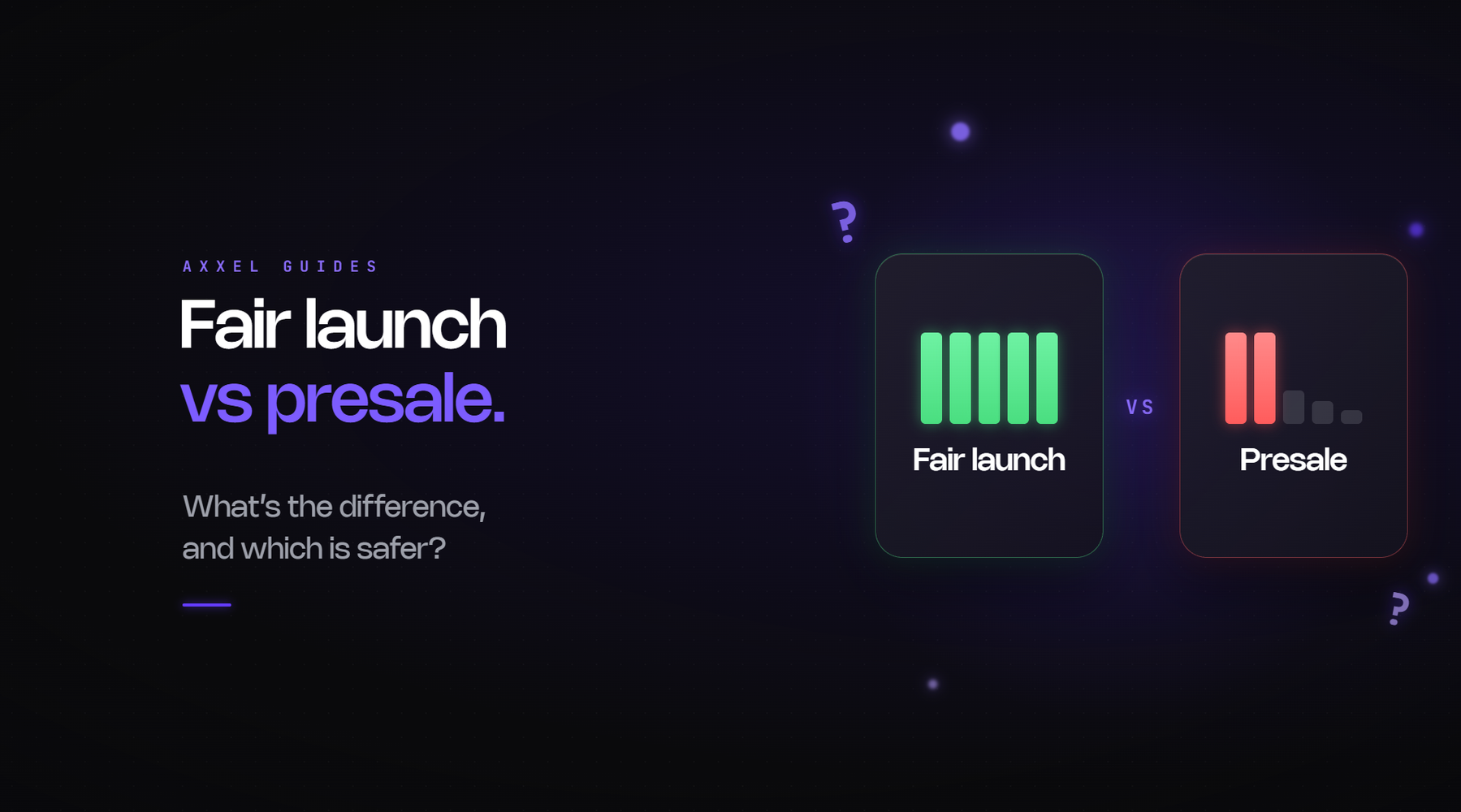
Two words on every launch announcement, usually in capitals, usually meant to reassure. Worth knowing what they actually promise, because it's less than it sounds.
What a fair launch is
No pre-allocation. The token goes live and the first buyer is the first holder, same price and same access for everyone. Bonding curve launchpads are built on this idea: the curve starts at zero, anyone can buy, and the creator holds nothing unless they buy like everyone else.
How it gets gamed
"Everyone has the same access" is true for about one block. Then the bundlers have bought 30% across a dozen wallets, the snipers have the next 10%, and the fair launch is a token with concentrated supply and a clean label. What is a bundled token is the mechanism, and the dev buy at launch, where the platform prompts the creator to buy their own token first, is the legitimate version of the same head start.
So a fair launch is fairer than the alternative, not fair. The check is the first few blocks: who bought, how much, and whether they're connected.
What a presale is
Tokens sold before the public launch, usually at a discount, to raise money for liquidity, marketing or the team. You send SOL or ETH to an address or through a form, and you get an allocation when it launches.
How it gets gamed
Three ways, in order of frequency.
It never launches. The address collects, the socials go quiet, there was never a token. The simplest scam in crypto, and still the most common presale outcome on small projects.
It launches and the presale sells. Buyers who got in at a discount sell into the public launch. The public is the exit for the presale, by design.
The allocations were never real. The team ran the presale, kept most of the supply, and used the raise to pay for the pump. How do pump and dumps work covers the rest.
Which is safer
Neither, but they fail differently, and the fair launch failure is the one you can check in advance.
A fair launch's risk is visible on-chain within minutes: bundled supply, sniper concentration, a deployer with a history. The five-minute routine catches most of it.
A presale's risk is mostly before the chain exists. You're trusting a team, an address and a promise, with no transaction history to read. The checks that matter are whether the team is identifiable, whether the raise sits in a verifiable escrow or a multisig, whether presale tokens are vested rather than unlocked at launch, and whether the allocation is small relative to supply. Most presales fail at least two of those, and the ones that pass all four are usually not memecoins.
The honest rule
If you're reading this, don't do presales. The upside is a discount on a token that doesn't exist yet. The downside is everything you sent. The people for whom presales work are the people who don't need a guide.
Fair launches you can at least verify, and the question isn't whether it was fair but how unfair, which the holder distribution and the deployer will tell you.
Axxel includes token analysis alongside sniper, market, limit and trailing orders, stop loss and take profit, MEV protection and configurable slippage across Ethereum, Base, BSC, Solana and Robinhood Chain. Flat 0.9%, non-custodial, no subscription.
Fair means nobody was before you on paper. Check the chain for who was before you in practice.
Crypto trading carries risk. Most memecoins lose value. Nothing here is financial advice. Axxel is not available in all regions.