How Do Pump and Dumps Work? The Memecoin Version
The playbook step by step, from deploy to dump, and the signals that show you which stage you're looking at.

Merlin
Author
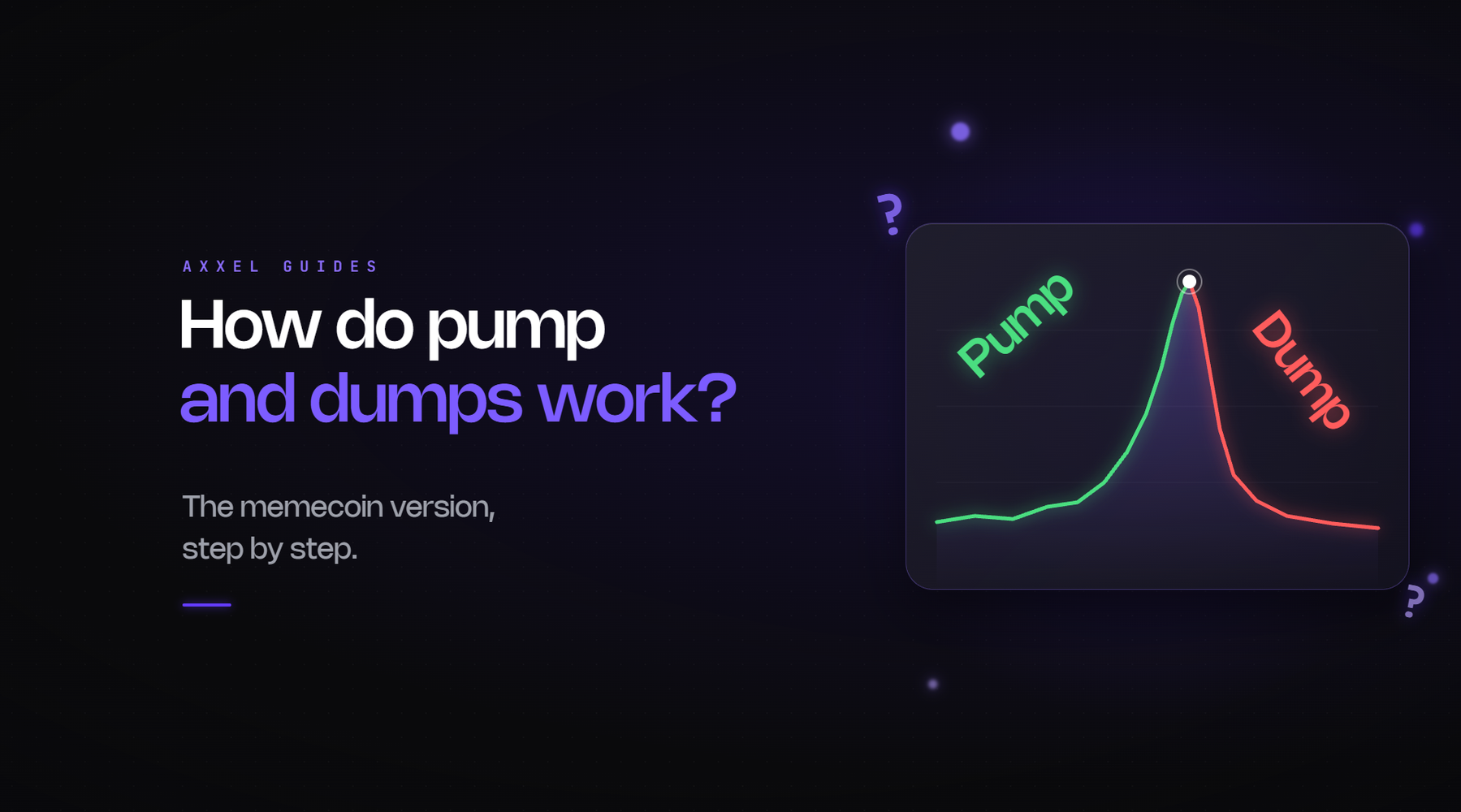
A pump and dump is a coordinated effort to inflate a token's price, attract outside buyers, and sell to them. In regulated markets it's a crime. In memecoins it's a Tuesday, and the only defence is knowing the sequence well enough to see which stage you've walked into.
Why memecoins are the natural habitat
No fundamentals to contradict the story. Thin liquidity, so small money moves price a lot. Anonymous teams. Launch costs near zero. And a buyer base that's primed to believe a 400% candle is information rather than someone selling.
The playbook, in order
Stage one: setup. Deploy the token. Buy a large share of supply in the first block across a dozen connected wallets, which is a bundle. Fund a few more wallets to use later. On the holder list this looks like healthy distribution. It's one operation.
Stage two: the pump. Generate volume by trading between your own wallets, which is wash trading. Pay for trending placement. Pay or seed a few accounts to post it, which becomes a cosign. Drop it in group chats with a fake catalyst: a listing, a partnership, a celebrity. The chart now looks like a coin that's discovered itself.
Stage three: distribution. Real buyers arrive on the chart and the posts. The operation sells into them across its wallets, slowly enough that the price keeps rising for a while. The deployer wallet itself often doesn't sell yet, so "dev holds" still looks fine. The selling is happening from the wallets nobody's labelled.
Stage four: the dump. The buying slows, the operation finishes selling, and there's nothing underneath. Thin liquidity means the collapse is fast. On a bonding curve launch the pool was tiny to begin with. On a direct deployment they may pull liquidity entirely, which is the rug.
Stage five: the aftermath. A "community takeover" that's the same wallets with a new story. A relaunch under a new name with the same holder cluster. And the recovery scams that target the people who bought stage three.
What each stage looks like on-chain
Setup: high bundled percentage, several top holders funded from one address, deployer with a history of dead tokens.
Pump: volume rising while holder count is flat. Trending placement that doesn't match organic social activity. Accounts posting it who bought from fresh wallets shortly before.
Distribution: the labelled top holders unchanged, but net selling from wallets that trace back to them. Price rising on falling buy size.
Dump: liquidity that can't absorb a mid-sized sell. Then it doesn't need describing.
The checks for all of it are in the five-minute routine, and the one that catches most of this early is the funding trail.
The honest nuance
Not every coin that runs and dies was a scheme. Most memecoins have pump-and-dump dynamics without anyone coordinating, because attention arrives, attention leaves, and the exit liquidity is whoever bought last. The difference between a scheme and a dead meta is intent and concentration: one entity holding most of the supply and manufacturing the attention, versus a crowd that got excited and then didn't.
From the outside both look like a chart that went up and came down. From the holder list and the funding trail, they look completely different.
On the groups
Coordinated pump groups exist and they recruit openly. The pitch is that everyone buys together and everyone wins. The maths is that the organisers are in before the announcement and the members are the exit. If you're reading the call, you're not the one it's for.
Axxel includes token analysis alongside market, limit, trailing and sniper orders, stop loss and take profit, MEV protection, configurable slippage and tax limits across Ethereum, Base, BSC, Solana and Robinhood Chain. Flat 0.9%, non-custodial, no subscription.
The scheme needs you to see the chart and not the wallets. Look at the wallets.
Crypto trading carries risk. Most memecoins lose value. Nothing here is financial or legal advice. Axxel is not available in all regions.