Why Did My Transaction Fail? Every Cause and the Fix for Each
Nine reasons a swap doesn't go through, how to tell which one you hit, and why you still paid for it.

Merlin
Author
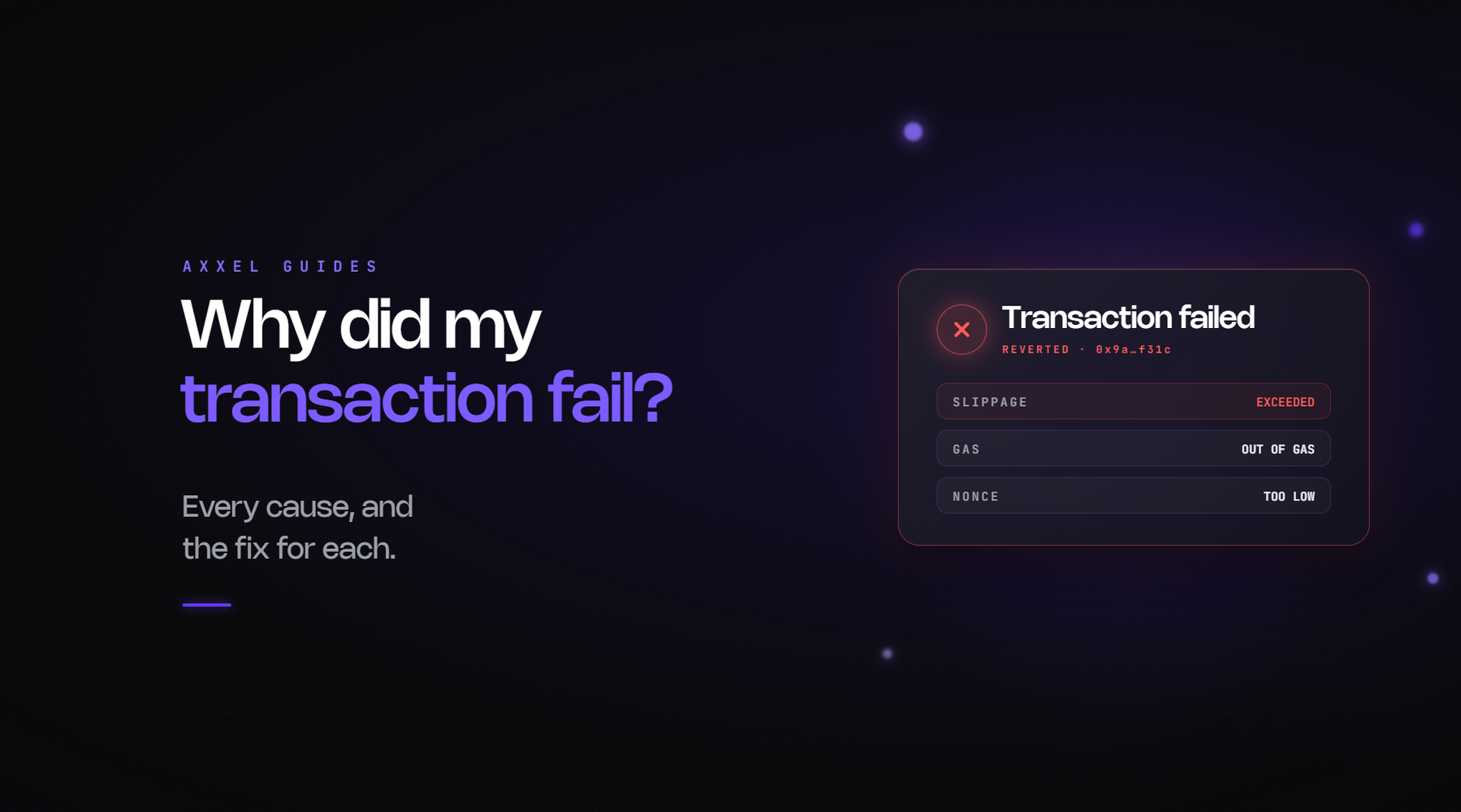
A transaction fails, you paid gas for it anyway, and the price moved while you were retrying. It's the most common practical problem in on-chain trading and most people fix it by cranking slippage, which is the wrong fix for most of the causes.
Here's each cause, how to spot it, and what actually resolves it.
1. Slippage too tight
The most common by a distance. Between submitting and confirming, the price moved more than your tolerance allowed, so the transaction reverted rather than fill at a worse price.
Tell: the error mentions slippage, minimum output, or "insufficient output amount." Happens most on tokens that are moving fast.
Fix: widen slippage, but by a little and deliberately. Going from 1% to 3% on a fast mover is reasonable. Going to 40% is what makes you a sandwich target. The slippage guide covers the trade-off.
2. Token tax exceeds slippage
On EVM chains, a token with a 10% buy tax and your slippage at 5% will fail every time, because the contract takes more than you've allowed for. It looks like a slippage problem and isn't.
Tell: it fails repeatedly on the same token regardless of how fast it's moving, and it's on BNB Chain, Ethereum or Base.
Fix: check the token's tax before touching slippage. If it's 10%, your tolerance has to cover 10% plus real movement. If the tax is high enough that you'd need 25% slippage, that's the token telling you something.
3. No gas
You have the tokens, you don't have enough of the chain's native asset to pay for the transaction. Common after a few trades drain your ETH or SOL balance.
Tell: error mentions insufficient funds for gas, or the wallet won't even let you submit.
Fix: top up the native token. Keep a buffer so this doesn't happen mid-trade. Covered in what is gas.
4. Priority fee too low
On Solana particularly, during busy periods your transaction may not get included before it expires. Technically it didn't fail so much as never happen.
Tell: transaction sits pending then disappears, often with a "blockhash expired" or timeout message. Happens during launches and volatile periods.
Fix: raise the priority fee for the trade. Most bots have a setting for this. Worth having a higher preset for launches and a lower one for everything else.
5. It's a honeypot
Buys work, sells fail. The contract is built so you can't exit.
Tell: buy went through fine, every sell attempt fails regardless of slippage or gas.
Fix: there isn't one for the position. The fix is the test sell before you commit real size, covered in what is a honeypot.
6. Liquidity moved
Between quote and execution, the pool changed enough that the route no longer works. Someone pulled liquidity, or a large trade drained one side.
Tell: a quote that looked fine seconds ago now fails with a route or liquidity error.
Fix: re-quote. If the pool's gone, so has the trade, and that's probably a rug in progress.
7. Deadline expired
Swaps carry a deadline. If the transaction isn't included by then, it reverts.
Tell: error mentions deadline or expiry. Usually accompanies a low priority fee.
Fix: same as cause 4. Get included faster.
8. Missing approval
On EVM chains, selling a token requires an approval transaction first. If it hasn't happened or was revoked, the sell fails.
Tell: sell fails on a token you've never sold before, error mentions allowance or approval.
Fix: approve, then sell. Most interfaces handle this automatically; some bots require it as a separate step. Background on why in token approvals explained.
9. Wrong network or wrong contract
You're on Base trying to trade a token that lives on BNB Chain, or you've pasted a copycat contract with no real pool.
Tell: token not found, no route, or a pool with no liquidity.
Fix: confirm chain and contract address from the project's own source.
The cost of failing
Failed transactions still pay gas on most chains, because the network did the work of attempting them. Three failures at a low setting can cost more than one success at a sensible one, and while you're retrying the price is moving away.
Which is the case for diagnosing rather than retrying. If it fails once, look at why before submitting again. Usually it's one of the first four, and each has a specific fix that isn't "more slippage."
Diagnosing quickly
Read the error message, it usually names the cause. If it doesn't, ask in order: is this token taxed, is it moving fast, have I got gas, is the network busy. That covers most cases in under a minute.
The fee breakdown covers what failed transactions add to your real cost over time, which is more than most people track.
Axxel supports configurable slippage, priority fees and maximum tax limits, so orders won't attempt tokens that breach your thresholds, alongside market, limit, trailing and sniper orders, stop loss and take profit, and MEV protection across Ethereum, Base, BSC, Solana and Robinhood Chain. Flat 0.9%, non-custodial, no subscription.
Most failures are one setting. Find which one before you change all of them.
Crypto trading carries risk. Most memecoins lose value. Nothing here is financial advice. Axxel is not available in all regions.